Cordless blowers have quietly eaten into gas territory over the past few seasons. Yard cleanup, keyboard dust, sawdust in the shop, water spots on a freshly washed car: all of it now gets handled by a tool you grab with one hand and stash in a closet. This lineup covers the two camps, big-yard leaf work and small-precision air dusting, so the right tool lines up with the right mess.
The Lineup, Simplified

WOLFBOX MT500 Cordless Leaf Blower (40V, 2 Batteries)
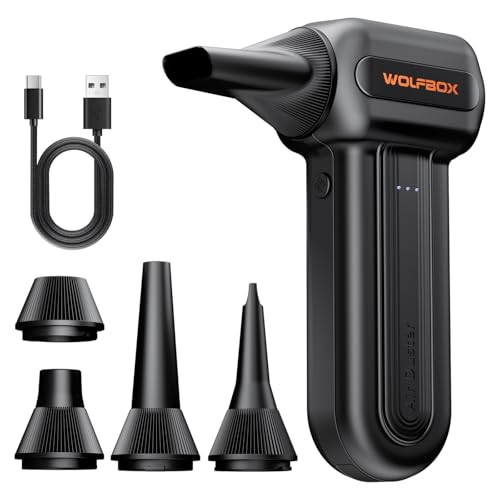
WOLFBOX MF60 Compressed Air Duster (3-Speed, 110,000 RPM)

WOLFBOX MF70 Compressed Air Duster (3-Speed, Cordless)

WOLFBOX MF100 Compressed Air Duster (150,000 RPM, 45 m/s)

WOLFBOX MF200-2PK Compressed Air Duster (2 Batteries, Case)

WOLFBOX MT600 Cordless Leaf Blower (620 CFM, 2 Batteries)

WOLFBOX MegaFlow 50 Compressed Air Duster (Mini, 4 Nozzles)

WOLFBOX MF200 Compressed Air Duster (Removable Battery)

BOSCH GBL18V-450N18 18V Blower Kit (8Ah Battery)
What Each Pick Brings To The Table
The MT500 sits in the comfortable middle of WOLFBOX’s yard blower range, and for most suburban lots that’s exactly the right zone. A brushless motor moves 500 CFM (cubic feet of air per minute) at up to 130 MPH, which is enough to push a wet carpet of autumn leaves off the driveway without a pull cord or fuel can in sight.
Two batteries ship in the box, so a depleted pack does not ground the whole afternoon. A single-touch turbo button gives you a 15-second burst when the leaves are damp or the gutter debris is packed down. Owners should plan to wipe the air intake occasionally; leaf dust tends to settle there during long fall sessions.
A Few Strong Suits
- Dual batteries mean you can rotate packs and finish a full cleanup without waiting on a charger.
- Brushless motor (a motor that uses electronic commutation rather than carbon brushes, so it runs cooler and lasts longer) keeps output steady without the maintenance of brushed designs.
- 500 CFM airflow handles mid-size yards in a single pass for most homeowners.
- Turbo mode is genuinely useful for wet leaves that refuse to budge.
Points To Keep In Mind
- 130 MPH trails the MT600 below, so very large acreage may demand more passes.
- Turbo draw drains the pack faster, so keep a second battery staged during heavy jobs.
Right Fit For
Homeowners clearing driveways, patios, and modest lawns through a typical leaf season.
Skip It When
You manage a half-acre or more of dense trees: the WOLFBOX MT600 Cordless Leaf Blower moves noticeably more air for that workload.
Half a pound and roughly the size of a TV remote: the MF60 is the air duster you keep in a desk drawer until something sticky needs sorting. A brushless motor peaks at 110,000 RPM, which translates to a focused jet rather than a wide gust. Three speed gears let you dial down when blowing around a laptop keyboard or PC fan.
It also handles the small household messes a can of compressed air used to fix: crumbs in a toaster, dust in a camera sensor area, pet hair on a shelf. Charging is fast enough that a quick top-up between sessions is realistic. Filter screens tend to collect fine lint, so plan a quick visual check every few weeks.
Useful Touches
- Three gear settings cover both delicate electronics and tougher desk debris.
- 0.5 lb weight means handheld fatigue is rarely an issue during short cleanups.
- Rechargeable design replaces the disposable canned-air habit over time.
Small Caveats
- Lower airflow than the MF100 or MF200 below, so deep dust in crevices may need a nozzle attachment.
- At 110,000 RPM top speed, it is still a desktop tool rather than a workshop blower.
Made For
Remote workers and casual PC users who want a tidy keyboard without disposable air cans.
Look Elsewhere When
You clean PC builds weekly or run a small repair bench: the WOLFBOX MF100 Compressed Air Duster delivers stronger, more sustained airflow.
The MF70 sits one rung above the MF60 in the WOLFBOX duster family, and the difference shows in the way it handles fiddly PC work. Same 110,000 RPM ceiling, same three-gear layout, but with a slightly more aggressive motor tune for surfaces that fight back, like radiator fins packed with months of dust.
PC builders and hobbyists tend to reach for a duster like this between upgrades, and the MF70 fits that rhythm. It clears a case interior in roughly the time it takes to swap a graphics card. For tougher workshops with persistent sawdust, the MF200 pair a few slots down makes more sense.
What Pays Off
- Three-speed control is genuinely useful across keyboards, fans, and case interiors.
- Brushless motor (no carbon brushes to wear out) keeps the unit consistent across many short sessions.
- Replaces canned air for routine cleanups, which adds up over a year of use.
Honest Caveats
- Airflow tops out below the MF100, so deeply embedded dust still takes patience.
- Battery is internal, so heavy daily use means planning a charging window.
Key Specs
Best Suited To
PC builders, hobbyists, and casual tech tinkerers maintaining clean internals between upgrades.
Not Your Match When
You run a small repair bench with daily cleaning: the WOLFBOX MF200 Compressed Air Duster offers more sustained airflow and a swappable battery for that pace.
Step up to the MF100 and the conversation shifts from “dust buster” to “tool.” A turbo fan peaks at 150,000 RPM and pushes air at roughly 45 m/s, which is genuinely impressive for a handheld unit. Three speed settings keep the lowest gear tame enough for camera sensors, while the top gear blasts packed lint out of server fans.
The package ships with five nozzles and two brushes, which is the kind of detail that matters when you’re moving between a keyboard, a DSLR mirror box, and a workshop vacuum filter. The MF100 is the right tool for anyone whose cleaning needs have outgrown the average canned-air approach.
Bright Spots
- 150,000 RPM top speed handles dust that lower-RPM dusters leave behind.
- Multiple nozzle and brush attachments cover everything from keyboards to camera gear.
- Three speed gears let you ramp up for stubborn jobs without losing finesse for delicate work.
Where It May Fall Short
- Higher airflow drains the battery faster, so plan extra charge time during heavy sessions.
- More attachments to keep track of than simpler models like the MF60.
Feature Snapshot
Perfect Match For
Gamers, tech enthusiasts, and photographers who clean gear regularly and need real pulling power.
Reach For A Different Pick When
You want zero downtime between sessions: the WOLFBOX MF200-2PK Compressed Air Duster pairs a swappable battery with a hard case for that workflow.
Where the MF100 is the enthusiast’s tool, the MF200-2PK Pro Kit is built for the person who cleans gear as part of the job. Two swappable batteries ship in the box, plus a hard case that keeps nozzles, brushes, and packs organized between calls. That sounds like packaging flair until you’ve tried running a detailing session on a single cell.
The hurricane-grade airflow (the brand’s high-output tier) lifts dust, pollen, and fine debris from crevices that ordinary dusters miss. For detailers, IT technicians, and small-shop pros, the workflow beats fighting a tethered canned-air habit. The case adds bulk, so casual users may prefer the lighter MF100.
Real-World Strengths
- Swappable batteries mean continuous use without waiting for a charge cycle.
- Hard case keeps nozzles and accessories organized for mobile work.
- High-pressure output handles tougher debris than entry-level dusters.
- Built for professionals who use it multiple times a day.
Practical Considerations
- Bulkier than single-cell dusters like the MegaFlow 50, so it is less pocketable.
- Pro positioning shows in the price band, so casual users may not need the second battery.
Whose Shelf It Belongs On
Detailers, IT techs, and small-shop pros who need non-stop cleaning across long sessions.
A Better Fit Elsewhere
You only dust occasionally: the WOLFBOX MegaFlow 50 Compressed Air Duster is a lighter one-handed alternative for quick cleanups.
The MT600 is WOLFBOX’s top-of-line yard blower and the natural step up from the MT500. Its brushless motor pushes 620 CFM at 150 MPH, which is the airflow range you typically saw on small gas units a few seasons ago. Two interchangeable nozzles cover wide-area clearing and tight crevice work.
Round nozzle for a patio sweep, flat nozzle for a wet leaf pile stuck against the garage door, flat nozzle again for drying water spots off a freshly washed car. The kit ships with two batteries, so a long cleanup does not stall on a depleted cell. For most suburban lots, the MT500 is plenty; this one earns its place on larger or debris-heavy properties.
What Makes Sense
- 620 CFM airflow moves heavy or wet debris faster than mid-tier alternatives.
- Two nozzles add real versatility for yard work and detailing alike.
- Twin batteries keep the work moving through long cleanup sessions.
Less Ideal Details
- More power means more weight to shoulder on long jobs.
- For small patios, the airflow is more than the work requires.
Quick Facts
Built With In Mind
Owners of bigger lots, tree-lined driveways, and small properties where heavy fall cleanup is the norm.
Where A Sibling Pick Shines
You only clear a small driveway and patio: the WOLFBOX MT500 Cordless Leaf Blower covers that workload at a more comfortable carry weight.
The MegaFlow 50 is the smallest entry in this lineup at 0.45 lb, and that lightness shows up everywhere. It slips into a laptop bag, a camera pouch, or a kitchen drawer without rearranging anything else. The motor still reaches 110,000 RPM across three adjustable gears, which is plenty for keyboards, vents, and the random crumb that migrates behind a monitor.
Four nozzles come in the box, covering narrow gaps and wider sweeps. Fast charging matters more here than on bulkier models, since travelers often grab the tool between flights or hotel stays. For heavier work back home, the MF100 or MF200 still make more sense.
Where It Excels
- 0.45 lb weight is genuinely pocketable for daily carry.
- Three-gear control adjusts to keyboards, vents, and small crevices.
- Fast charging fits between-meeting top-ups.
Things To Consider
- Lower output than the MF100, so deep dust in PC cases takes longer.
- Smaller body means smaller battery capacity versus larger dusters.
Who Should Grab It
Travelers, remote workers, and minimalists who want a grab-and-go duster for everyday messes.
Swap It Out When
You clean PC interiors regularly: the WOLFBOX MF100 Compressed Air Duster offers substantially stronger airflow for that workload.
The MF200 trades the sealed-cell design of smaller dusters for a swappable 22.2Wh battery, which is the kind of feature that changes how a tool feels day to day. You can stage a second pack, charge the tool or battery independently through USB-C, and reach roughly 100 minutes of runtime at the lowest speed setting.
That flexibility plays well across car interiors, home electronics, and small workshop jobs. Owners commonly pair this with a dedicated cleaning routine, treating the battery as the swap-out between sessions. Without buying the 2PK kit above, you still get the convenience of a single removable cell rather than waiting for an internal pack to recharge.
Where It Helps
- Removable battery removes the recharge downtime that plagues fixed-cell dusters.
- USB-C charging fits existing cables and travel setups.
- Runtime stretches to roughly 100 minutes at the lowest gear for routine jobs.
Some Limits To Know
- Higher speeds reduce runtime, so heavy jobs still demand a charged spare.
- Extra battery adds cost compared with single-cell dusters like the MegaFlow 50.
Spec Overview
Who It Suits Best
Car owners, home detailers, and hobbyists who split cleaning between sessions and dislike waiting on internal packs.
Consider Something Else When
You run long professional sessions back to back: the WOLFBOX MF200-2PK Compressed Air Duster bundles a second battery and case for true zero downtime.
The Bosch GBL18V-450N18 leans into the brand’s 18V ecosystem, and that single detail changes how the kit fits into a household. Owners of other Bosch 18V tools already have batteries and chargers, which makes this an easy add-on rather than a new platform. The included 8Ah pack is on the chunky side, though, so first-time users should plan for the heft.
Output sits at 450 CFM and 123 MPH from an axial fan, which is comparable to WOLFBOX’s MT500 range. A speed-control wheel lets you dial back output for noise-sensitive jobs or stretch the runtime when full power isn’t necessary. Compared to the WOLFBOX MT500, this trades a higher top CFM for brand ecosystem familiarity.
Reasons It Performs
- Shares batteries with other Bosch 18V tools you may already own.
- Variable-speed wheel adjusts output and noise to the job at hand.
- 8Ah battery delivers long runtime for moderate cleanup sessions.
Worth Noting
- 450 CFM trails the WOLFBOX MT600 by a wide margin for tough debris.
- First-time users buying into the Bosch 18V line need to budget for chargers.
Feature Card
Right Fit For
Existing Bosch 18V tool owners who want a single ecosystem across drills, saws, and outdoor gear.
A Better Fit Elsewhere
You want maximum airflow for large or debris-heavy lots: the WOLFBOX MT600 Cordless Leaf Blower pushes noticeably more air.
What Matters When Choosing Battery Air Blowers
Match The Tool To The Mess
Big-yard debris and small-precision dust are different worlds under the same name. Yard blowers are measured in CFM (cubic feet of air per minute) and MPH, where higher numbers move more leaves faster. Desktop dusters are measured in RPM (revolutions per minute of the internal fan), and the trade-off shifts toward noise, nozzle options, and weight. Picking the wrong family leaves you overpaying for power you never use, or underpowered for the work in front of you.
Airflow Numbers In Real Terms
A 450 to 500 CFM blower handles a typical suburban driveway and patio with one or two passes. Move toward 600+ CFM and you’re in larger lots, wet leaves, and tougher debris. On the duster side, 110,000 RPM is the everyday benchmark, while 150,000 RPM and beyond handle stubborn PC interiors, server fans, and equipment that has gone too long between cleanings. Higher numbers are not always the right choice: they drain batteries faster and add weight.
Battery Strategy Matters
A single internal cell is fine for occasional use, but heavier routines benefit from a swappable or bundled second battery. Yard blowers in particular lose value quickly if you cannot finish a cleanup on one charge. USB-C charging, included chargers, and dual-battery kits all shape ownership more than the headline CFM figure does. Pair runtime claims with the kind of job you actually run, not the best-case scenario.
Reader Profile Snapshot
Homeowners with mid-size yards, PC builders maintaining clean internals, detailers working on cars, and travelers who want a grab-and-go tool each have a different ideal pick. The WOLFBOX MT500 and MT600 cover the yard side, while the MF60, MF70, MF100, MF200, and MegaFlow 50 split the duster market by speed, weight, and battery flexibility. The Bosch kit appeals most to shoppers already inside an 18V platform.
Shopping Smarts Across These Picks
Pitfalls Shoppers Hit
Buying on raw CFM or RPM alone is the most common trap. A 620 CFM blower feels great in the spec sheet and exhausting on a small patio. Likewise, a 150,000 RPM duster is overkill for a kitchen crumb. Match output to workload, and look at the second-tier features: nozzle count, swappable batteries, included accessories, and weight. Those details shape daily use far more than peak numbers.
Where The Extra Money Goes
Premium tier earns its keep in three places: motor durability (brushless designs last longer), battery systems (swappable cells, dual packs, fast charging), and accessory kits (multiple nozzles, brushes, hard cases). The MT600, MF200-2PK, and MF100 cluster at the top because those features stack. Entry picks make sense for lighter routines; the upgrade pays off when the tool earns its keep across multiple weekly sessions.
Frequently Asked Questions
How long do batteries typically last on a single charge?
Runtime depends heavily on the speed setting. Yard blowers from WOLFBOX advertise roughly an hour or more on lower settings, with shorter bursts at full power. Desktop dusters stretch up to around 100 minutes at the lowest gear, scaling down as RPM climbs. Treat published runtimes as best-case figures for low-output use.
Are cordless leaf blowers strong enough for wet leaves?
Mid-tier cordless blowers at 500 CFM and above handle damp leaves reasonably well, especially with a turbo burst. Very wet, packed piles still benefit from higher-tier units like the WOLFBOX MT600, or from working in smaller sections rather than trying to clear everything at once.
What is the difference between CFM and MPH on a blower?
CFM measures the volume of air moved per minute, which controls how much debris you shift at once. MPH measures air speed, which controls how forcefully that air pushes material off a surface. The best results come from a balance of both: high CFM for volume, high MPH for stubborn patches.
Can compressed air dusters replace canned air entirely?
For most household and PC use, yes. Rechargeable dusters deliver stronger sustained airflow than a typical aerosol can and avoid the disposable waste stream. Cans still have a niche for one-off travel cleanups where carrying a duster isn’t practical.
Do I need multiple nozzles for a desktop duster?
Multiple nozzles help when you clean different surface types: tight crevices, broad keyboard sweeps, or sensitive camera gear. A single nozzle works fine for routine keyboard and desk cleanup, but more variety pays off once you start using the duster for PC interiors, vents, and household tasks.