A dead battery doesn’t care what year it is. One freezing morning, one parasitic draw, or one aging cell, and your car sits there clicking in the driveway while you call for help. The good news: a small collection of the right gear, terminals, jump posts, a fresh AGM battery, or a portable booster, can turn that worst kind of day into a 10-minute inconvenience. This roundup covers the cables, connectors, relocation kits, full batteries, and jump starters most home mechanics and weekend tinkerers actually reach for.
The Main Contenders

HEROFFIX Battery Inverter Cable 3/8″ Lug 6FT Black Tinned Copper

EAPP 90982-06022 Negative Terminal Assembly with Nut (25 Pack)
Kikerike Battery Jump Post Kit with Bracket Cable

vvag 91980-3X010 Positive Battery Terminal Connector

Kikerike 2-Piece Battery Jump Post Kit with Bracket

Kikerike 250A Remote Battery Terminals with 4AWG Cable

MARXON Group 48 H6 L3 AGM 12V 70Ah Battery

Amcelooy 2000 Peak Amp 12V Jump Starter

Amcelooy 2400A 6-in-1 Jump Starter Power Station

Amcelooy 2000A Jump Starter with Air Compressor
The Details Behind The Selections
Long cable runs between a battery and an inverter or secondary accessory demand serious conductor mass. The HEROFFIX 1/0 AWG cable fits that brief, using tinned copper wrapped in a PVC jacket that resists wear and moisture in engine bay heat. The 3/8-inch lugs at each end land cleanly on common battery posts and inverter studs.
For a home installer wiring a sound system, a solar charge setup, or a power-hungry winch, that gauge translates directly into less voltage drop over distance. You notice it most when equipment draws hard at idle: lights stay brighter, amplifiers stay cleaner, and the alternator breathes easier.
Benefits That Matter
- 1/0 AWG tinned copper carries high current with minimal voltage drop.
- PVC jacket stands up to under-hood temperatures and abrasion over time.
- 3/8-inch ring terminals match common battery and inverter stud sizes.
- Six-foot length gives routing flexibility for trunk-mounted batteries.
Things To Consider
- Single cable only, so you may need a second run for a complete positive-negative pair.
- Lugs arrive ready to crimp, so a proper tool matters for a gas-tight connection.
Right Fit For
Garage tinkerers running an inverter, big stereo, or auxiliary lighting who need one beefy cable rather than a full kit.
Consider Something Else When
You need a positive-and-negative pair with hardware included, in which case the Kikerike 250A Remote Battery Terminals kit is a more complete package.
A 25-pack of OE-style negative terminals sounds excessive until you remember how often a corroded post eats a Saturday morning. EAPP’s replacement assemblies match the 90982-06022 / 90982-06032 spec used across older Toyota and Lexus models, which is a quietly huge coverage list once you include Camry, Avalon, ES300, and SC400 cars still on the road.
Each unit ships with the M8 nut, so there is no scavenger hunt through the parts bin mid-repair. For a small shop, a fleet mechanic, or a hobbyist who refuses to buy one terminal at a time, this bulk format is the honest answer.
Notable Gains
- Bulk format trims cost-per-repair for shops doing regular battery service.
- Direct-fit design matches the original Toyota/Lexus negative clamp geometry.
- Included M8 nut removes the need to source fasteners separately.
- Wide compatibility across older Camry, Avalon, ES300, SC300, and SC400 models.
Points To Note
- Model-specific, so it is the wrong call for GM, Ford, or most Korean vehicles.
- 25 pieces only make sense for repeat use; one-off shoppers may prefer a single OE terminal.
Feature Snapshot
Best Suited To
Small independent shops and home mechanics who service older Toyota and Lexus vehicles often enough to justify stocking terminals in volume.
Look Elsewhere When
You drive a Hyundai or Kia and need a positive terminal instead, where the vvag 91980-3X010 Positive Car Battery Terminal Connector is the closer fit.
Sometimes the factory battery location is the wrong location. Kikerike’s single-post relocation kit gives you a clean remote terminal, mounted on a bracket, that brings jump-start access up to a safer, more reachable spot. For UTVs, tractors, and tucked-away engine bays, that is the difference between a five-minute boost and removing a seat.
The included bracket and cable support a tidy install without forcing you to fabricate anything. Pair it with the relocated battery of your choice and you have freed up real estate for a cold-air intake, an intake manifold upgrade, or simply more room to work on the bay.
The Helpful Details
- Remote post moves jump-start access out of crowded engine bays.
- Included bracket simplifies mounting without custom fabrication.
- Cable and hardware arrive together, so no second order is required.
- Works across UTVs, ATVs, trucks, RVs, tractors, and boats.
Honest Caveats
- Single post only, so you need to source a second post separately for a complete positive-and-negative relocation.
- Bracket fits common layouts but may need adaptation on unusual chassis.
Made For
Owners of UTVs, side-by-sides, and small tractors who want jump-start access without lifting body panels.
A Better Fit Elsewhere
If you want a matched pair of posts plus the wiring in one box, the Kikerike 2 PCS Battery Jump Post Kit is the closer match.
Replacing a positive battery terminal sounds simple until you discover how many aftermarket clamps refuse to seat correctly on Hyundai and Kia posts. The vvag 91980-3X010 is built to the OE Hyundai specification, so it lands on Accent, Azera, Veloster, Genesis G80, G90, Sedona, Soul, and Forte5 applications without shimming or filing.
That direct-fit approach removes the most common source of post-repair headaches: a clamp that looks right but feels loose, slowly cooking itself over months until the car refuses to start. For one-off repairs on a daily driver, that is the result you want.
Noteworthy Benefits
- OE-spec fit on a wide range of Hyundai, Kia, and Genesis models.
- Positive-side replacement targets the terminal that corrodes first on many cars.
- Direct-fit design eliminates improvisation with shims or adapters.
- Compact size keeps the OE battery cover in place after install.
Practical Considerations
- Limited to Hyundai, Kia, and Genesis vehicles from the listed model years.
- Single positive post only, so a negative-side repair needs a separate part.
Who It Suits Best
Hyundai and Kia owners replacing a green, crusty positive clamp on a 2015 through 2020-era daily driver.
Reach For A Different Pick When
You service Toyota or Lexus vehicles, where the EAPP 90982-06022 Negative Terminal Assembly covers the negative side in volume.
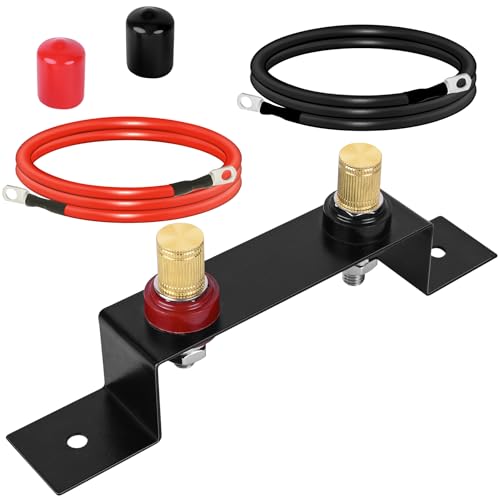
Where the single-post Kikerike kit leaves you sourcing a second clamp, this two-piece version closes the loop. You get a matched positive and negative remote post, both on the included bracket, with cable ready to reach a relocated battery. For custom engine bay builds, race cars, and overland rigs, that symmetry matters: posts line up, routing stays clean, and jump-start access ends up where you actually need it.
The kit shares the same chassis-spanning fitment as its sibling, covering UTVs, ATVs, trucks, RVs, tractors, and boats. For most home mechanics, the two-post version is the right starting point, since you avoid discovering mid-install that you need a second order.
Where It Delivers
- Matched positive and negative posts arrive together for a complete relocation.
- Bracket and hardware simplify mounting on common chassis.
- Wide fitment across UTVs, ATVs, trucks, RVs, tractors, and boats.
- Cable length supports trunk-mounted or rear-bay battery placements.
Some Limits To Know
- Cable gauge is not specified as heavy as the 4AWG version, so verify against your amp draw.
Built With In Mind
Builders and weekend fabricators running a clean dual-post relocation in a custom bay.
Swap It Out When
Your setup draws serious amperage from a winch or high-output stereo, where the Kikerike 250A Remote Battery Terminals with 4AWG cable handles the load more confidently.
This is the grown-up version of Kikerike’s relocation kit. You get a heavy-duty mounting bracket, two remote posts (positive and negative), a pair of 4.43-foot 4 AWG cables in red and black, terminal protector boots, heat shrink, and the small hardware that tends to disappear in the bottom of a toolbox. The 3/8-inch stud pattern fits most jump-start clamps and charger leads.
For a truck running a high-amp winch, an RV with a house battery bank, or a ride-on mower that needs remote charging access, the included 4 AWG cable is the meaningful upgrade over lighter relocation kits. You notice the difference at sustained draw, where thinner cables heat up and waste energy as voltage drop.
Strengths Worth Knowing
- 4 AWG cable supports sustained high-current draws without heating up.
- Complete kit includes bracket, posts, cables, boots, and heat shrink.
- 250A-rated posts handle jump-starting and charger clamp use.
- Red and black cables preserve proper polarity in the bay.
Worth Bearing In Mind
- More pieces to install than a single-post kit, so plan extra time.
- Cable length is fixed at roughly 4.43 feet, which may be short for trunk-mount setups.
Quick Facts
Whose Shelf It Belongs On
Truck and RV owners, plus ride-on mower users, who want one complete relocation kit rather than piecing parts together.
Where Another Pick Suits Better
You only need a single remote post for a UTV, where the Kikerike single-post kit is the lighter, simpler answer.
AGM (Absorbent Glass Mat) batteries live a tougher life than flooded cells, and the MARXON Group 48 (H6/L3) is built to handle modern start-stop systems. The 12V 70Ah capacity and 760 CCA (cold cranking amps) rating cover the energy demands of cars that automatically shut off at traffic lights and restart a dozen times per commute.
The BCI Group 48 case measures 10.95 x 6.89 x 7.48 inches and weighs roughly 46.5 pounds, matching the OE foot print on many mid-size sedans and crossovers. A1 terminal layout keeps cable orientation familiar for DIY installers.
Reasons It Performs
- AGM construction handles start-stop cycling that wears out flooded batteries.
- 760 CCA delivers confident cold starts in freezing climates.
- Maintenance-free design means no water top-ups over the service life.
- BCI Group 48 case matches the OE fit on a wide range of vehicles.
Where It May Fall Short
- Heavier than a typical flooded battery at around 46.5 pounds.
- Group 48 sizing only fits vehicles designed for that footprint.
Feature Card
Who Will Love This
Drivers of start-stop-equipped daily drivers who want a sealed AGM replacement rather than a flooded cell.
Not Your Match When
Your vehicle does not use Group 48, or you need a one-shot roadside rescue, where the Amcelooy 2000 Peak Amp Jump Starter is the better tool.
Portable jump starters earn their space in the trunk by working the first time you need them. Amcelooy’s 2000 peak amp unit is rated for gasoline engines up to 8.0 liters and diesels up to 8.0 liters, which covers everything from a Civic to a Power Stroke without breaking a sweat. The built-in LED light, USB port, and DC outlet turn it into a pocket-sized emergency station.
For commuters, rideshare drivers, and anyone whose car sits outside overnight, this is the kind of gear that converts a tow-truck call into a five-minute delay. The trade-off is that lithium jump packs lose charge sitting in the trunk, so most owners top them off every few months.
Where It Helps
- 2000 peak amps covers large gas and diesel engines up to 8.0L.
- Built-in LED light supports nighttime roadside use.
- USB and DC ports charge phones and run small 12V accessories.
- Compact form factor stores in a glove box or trunk organizer.
Practical Considerations
- Lithium chemistry self-discharges, so periodic charging is part of ownership.
- Not a substitute for replacing an aging battery that fails repeatedly.
Perfect Match For
Commuters and rideshare drivers who want a single compact tool for both jump-starts and phone charging emergencies.
Skip It When
You camp or overland and want an inflator and inverter built in, where the Amcelooy 2400A 6-in-1 Jump Starter pulls double, triple, and quadruple duty.
Where the smaller Amcelooy unit focuses on jump-starting, this 2400A version leans into “portable power station” territory. You still get a jump starter rated for up to 8.0L gas and 8.0L diesel engines, but the box also adds a 100 PSI air compressor, a 400-watt inverter, AC/DC/USB outlets, and an LED work light.
For campers, overlanders, and tailgaters, that combination replaces a handful of single-purpose tools. Inflating a tire after a low-pressure warning becomes a five-minute job, and a 110V outlet means small appliances actually run off the unit rather than draining the car battery.
Points In Its Favor
- 2400 peak amps tackles large-displacement gas and diesel engines.
- 100 PSI air compressor handles tire top-ups at trailheads and campsites.
- 400W inverter runs small AC appliances away from outlets.
- Six functions in one box reduce gear clutter in the trunk.
Where It Is Less Suited
- Larger and heavier than a simple jump pack, so it lives in the trunk, not the glove box.
- Higher feature count means more internal cells to keep charged.
Specs At A Glance
Who Should Grab It
Overlanders, campers, and tailgaters who want one box that jumps a car, inflates a tire, and runs a laptop.
Another Choice May Suit
Daily commuters who only need a jump starter, where the Amcelooy 2000 Peak Amp unit stays lighter and simpler.
The third Amcelooy entry on this list is the practical middle ground: a 2000 peak amp jump starter that pairs with a built-in air compressor, LED lighting, and DC ports. Rated for engines up to 8.0L on gas and diesel, it covers the same engine range as the slimmer 2000A unit while adding the inflation capability of the bigger 2400A box.
For a daily-driver emergency bag, this combination hits the most common roadside needs without the weight penalty of the full power station. You get a jump, a tire top-up, a work light, and a way to charge a phone, all in one box.
The Practical Payoff
- 2000 peak amps handle engines up to 8.0L gas and diesel.
- Built-in air compressor covers tire pressure emergencies.
- LED work light supports after-dark repairs.
- DC ports keep phones and small electronics charged.
Trade-Offs To Consider
- Larger than a basic jump pack, so trunk storage is the realistic home.
- Compressor duty cycle is shorter than a dedicated tire inflator.
Who It Suits Best
Daily drivers and road-trippers who want one emergency tool that handles both a dead battery and a soft tire.
Not Your Match When
You camp regularly and need an inverter for AC appliances, where the Amcelooy 2400A 6-in-1 unit covers the wider outlet list.
Matching Your Vehicle To The Right Gear
Buying auto parts car battery accessories starts with one question: what is actually wrong, or what is about to be? A corroded clamp is a different problem from a dead cell, which is different from needing emergency jump capacity. Match the part to the failure mode before matching it to the vehicle.
Group size and terminal layout matter more than people expect. The MARXON Group 48 battery only fits cars designed for that case footprint, and the vvag 91980-3X010 terminal only fits certain Hyundai and Kia posts. Always cross-check the spec sheet against your VIN or your existing part number before ordering, especially for terminals where aftermarket “universal” clamps tend to fit loosely and overheat over time.
Cable gauge drives performance in the parts shoppers underestimate. The HEROFFIX 1/0 AWG cable and the Kikerike 4 AWG relocation kit exist because thinner cables lose energy as voltage drop, especially over long runs to trunk-mounted batteries. Heavier copper costs more up front but pays back in cleaner power delivery and less heat under the hood.
Cold cranking amps and reserve capacity describe real-world starting behavior. The MARXON’s 760 CCA rating is what keeps a car cranking fast on a sub-zero morning. If you live somewhere that gets cold, that number deserves more weight than peak amp ratings on a portable booster, which measure a brief surge rather than sustained output.
Key Considerations Across These Picks
Common Shopping Slip Ups
The most expensive mistake is treating a battery accessory as universal. Terminals, cables, and group sizes are model-specific, so an Amazon search for “fits everything” usually returns a part that fits nothing well. Match by part number or VIN where possible, and avoid generic clamps that need shimming.
The second pitfall is underestimating cable gauge. A 4 AWG cable and a 6 AWG cable look similar in photos, but the heavier one handles winches, inverters, and high-output audio without heating up. Pick the gauge that matches your highest-amp accessory, not your average draw.
When Paying More Pays Off
The jump starter tier above $100 brings air compressors, inverters, and lighting that turn a one-trick gadget into a roadside kit. The AGM battery tier costs more than a flooded cell but lasts longer in start-stop service. Pay the difference when the gear has to work in cold weather, in heavy daily use, or in environments where a single failure ends the trip.