A trolling motor that goes silent halfway across the cove. A bilge pump that quits while you’re moored through a weekend storm. A house bank that slowly loses its edge over the off-season. These are the kinds of problems 12-volt marine battery chargers exist to solve, and they matter even more when you treat your boat as a second home rather than a weekend toy. The right charger keeps a starter battery ready to crank and a house bank topped off without cooking the plates. Whether you dock at a wet slip or store your boat in a driveway through winter, picking the right onboard or portable unit saves you from jump-starts and shortened battery life. This list rounds up ten solid options across price points and feature sets, from rugged waterproof onboard models to smart trickle units for off-season storage.
A Closer Look At The Lineup
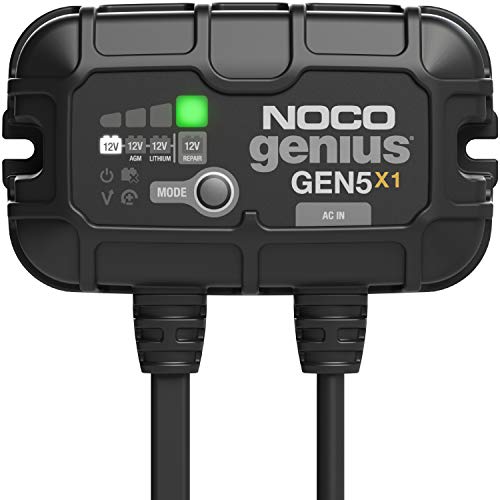
NOCO GEN5X1 12V 5A 1-Bank OnBoard Marine Battery Charger & Maintainer

CTEK 4.3 Test & Charge 12V Fully Automatic Charger

NOCO GEN5X2 12V 10A 2-Bank OnBoard Marine Battery Charger & Maintainer
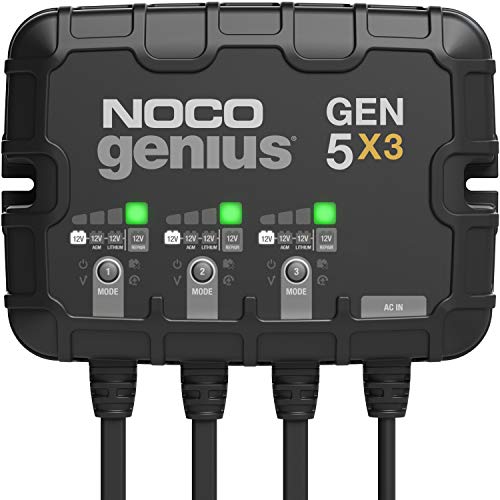
NOCO GEN5X3 12V 15A 3-Bank OnBoard Marine Battery Charger & Maintainer

BatteryMINDer 2012 12V 2Amp Smart Charger, Maintainer & Desulfator

BatteryMINDer 1510 12V 1.5A Smart Charger, Maintainer & Desulfator

OPTIMA D1200+ 12 Volt Performance Battery Charger and Maintainer
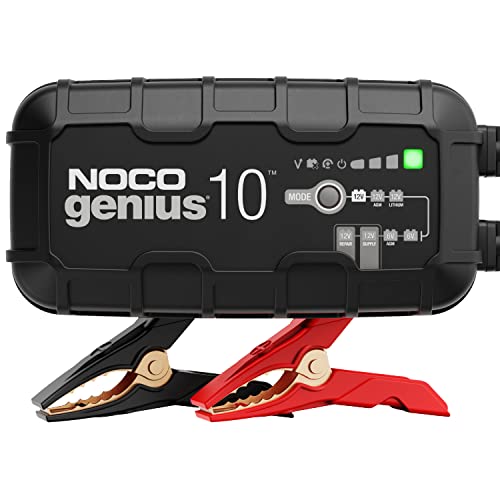
NOCO GENIUS10 10A 6V/12V Smart Battery Charger & Maintainer

NOCO GENIUS5 5A 6V/12V Smart Battery Charger & Maintainer

NOCO GENIUS2 2A 6V/12V Smart Battery Charger & Maintainer
Inside Each Recommended Option
The GEN5X1 is purpose-built for boats with a single 12-volt battery, packing a 5-amp charge output into a fully sealed, waterproof housing. It handles flooded, AGM, gel, and LiFePO4 lithium chemistries in one unit, which matters if your boat runs a lithium upgrade or still uses an older flooded cell. The compact footprint fits inside cramped console lockers where bulkier onboard units simply won’t go.
For weekend anglers running a small center console or a trolling-motor setup, this charger delivers reliable maintenance without overcomplicating the install. Compared to the GENIUS10 later in the lineup, you sacrifice raw charging speed for permanent-mount durability.
Everyday Wins
- 5A output handles most single 12V battery banks in reasonable timeframes
- Multi-chemistry support covers AGM, gel, flooded, and LiFePO4 batteries
- Sealed waterproof design handles bilge splashes and engine-bay moisture
- Compact housing fits tight console and under-seat installations
- Built-in temperature compensation adjusts output to ambient conditions
Things To Consider
- Single bank limits you to one battery or requires a separate charger for the house bank
- 5A output means slower recovery on deeply discharged large-capacity batteries
- Permanent-mount installation requires running AC shore power to the unit
Who It Suits Best
Owners of small runabouts and skiffs running a single deep-cycle or starter battery who want a permanent, set-and-forget onboard solution.
Look Elsewhere When
You run a separate starter battery plus a house bank; in that case the NOCO GEN5X2 handles both banks from a single mounted unit.
The CTEK 4.3 stands apart because it does more than push electrons into a battery: it tests both the battery and the alternator, telling you whether your charging system is healthy or hiding a problem. The patented recovery-and-maintain routine handles sulfated cells, which is a common culprit in batteries that seem to die overnight. Spark-free operation and reverse-polarity protection make it forgiving in a busy garage or a wet dock.
For boaters who store their vessel for months and want a clear readout of battery health before relaunch, the diagnostic side adds real value. Unlike the GEN5X1 reviewed earlier, this is a portable bench unit rather than a permanently mounted onboard charger, so it suits shore-power garages more than liveaboard installs.
Bright Spots
- Integrated battery and alternator testing reveals charging-system issues early
- Patented recovery routine helps bring weak batteries back from sulfation
- Spark-free connection and reverse-polarity protection prevent shop accidents
- Clean voltage delivery protects sensitive onboard electronics from spikes
Worth Noting
- Not waterproof, so it lives in the garage or cabin rather than the engine bay
- Single-bank design means swapping cables between batteries
Made For
Diy boaters who want diagnostic feedback alongside charging, especially those who store their boat through winter and relaunch seasonally.
Consider Something Else When
You need a permanently mounted waterproof solution that lives at the dock; in that situation the NOCO GEN5X1 stays installed and charges unattended.
The GEN5X2 doubles the GEN5X1’s footprint in usefulness, not in size. Two independent 5-amp banks let you charge a starter battery and a house bank simultaneously without one robbing the other. The fully sealed IP68-rated housing shrugs off rain, splash, and the kind of wet environment that lives inside a transom locker. Each chemistry profile is independently selectable, so a lithium house bank and an AGM starter can coexist without compromise.
For most center-console and dual-battery bay boats, this hits the sweet spot between capacity and form factor. Compared to the GEN5X3 reviewed next, you give up the third bank in exchange for a noticeably smaller install footprint.
The Upside
- Two independent 5A banks deliver tailored charging to different batteries
- IP68 waterproof rating stands up to the harshest engine-room conditions
- Multi-chemistry support covers AGM, gel, flooded, and LiFePO4 simultaneously
- Temperature compensation keeps output dialed in across seasons
- Compact relative to the multi-bank competition
Trade Offs
- 5A per bank means slower recovery on larger house banks
- Hardwired install needs access to AC shore power at the slip
Feature Snapshot
Best Suited To
Boaters running a separate starter and house bank who want a single mounted unit that manages both without manual cable swaps.
A Better Fit Elsewhere
You run three battery banks; the NOCO GEN5X3 covers a third bank in the same sealed housing family.
The GEN5X3 scales the GEN5X2’s sealed-onboard formula to three independent banks, each at 5 amps. That covers the classic three-battery arrangement: a starter, a house bank for cabin and accessories, and a dedicated trolling-motor bank that needs to be at full voltage before dawn. The IP68 waterproof housing means it lives happily in a transom locker or engine bay where spray and humidity are part of daily life.
For larger offshore boats, sailboats with separate banks for engine, domestic, and bow thruster, the third bank earns its keep. Against the GEN5X2, you trade a smaller install footprint for full multi-zone flexibility.
Useful Strengths
- Three independent banks handle starter, house, and trolling setups
- IP68 waterproofing stands up to permanent outdoor or bilge mounting
- Multi-chemistry support across all three banks
- Temperature compensation adjusts to seasonal climate swings
Room For Improvement
- 5A per bank means slow recovery on very large house banks
- Larger housing footprint demands dedicated mounting space
Perfect Match For
Larger boats with three distinct battery banks, including offshore rigs and sailboats where each bank serves a different load profile.
Skip It When
You run one or two banks total; the NOCO GEN5X2 covers a two-bank install in a smaller box.
The BatteryMINDer 2012 takes a different angle from the waterproof onboard units reviewed so far: it focuses on restoring neglected batteries rather than maintaining healthy ones. Sulfation (a buildup of lead-sulfate crystals that forms when a battery sits discharged) is the most common cause of early failure in stored marine batteries, and this unit uses high-frequency pulses to break those crystals down. Owners commonly find this useful when pulling a battery out of storage only to discover it won’t hold a charge.
For boaters with mixed-fleet responsibilities, a car, an RV, a lawn tractor, and a marine battery can all share one 2-amp charger. The trade-off versus the GENIUS10 below is current output; this unit restores rather than rapidly recharges large banks.
Why It Works Well
- Patented pulse desulfation recovers batteries written off as scrap
- 2A output is gentle enough for long-term float maintenance
- Multi-chemistry support handles AGM, gel, and flooded lead-acid
- Works across cars, motorcycles, lawn equipment, and marine batteries
Honest Caveats
- Not waterproof, so it belongs in a garage or cabin
- 2A is slow for recharging deeply discharged large banks
- Single-bank design means manual cable swapping for multiple batteries
At A Glance
Who Should Grab It
Boaters with neglected or stored batteries who want to extend battery life rather than replace it, especially over winter layup.
Another Choice May Suit
You need fast recovery on a large bank; the NOCO GENIUS10 delivers 10 amps and similar desulfation in a portable form factor.
The 1510 trims the 2012’s formula down to a 1.5-amp output with the same desulfation technology, suited to smaller marine batteries and shorter winter storage cycles. The integrated ambient temperature sensor adjusts output based on garage conditions, which matters if your shop swings from 40°F in October to 70°F in March. Reverse-polarity and short-circuit protection keep it safe in a busy workspace.
For boaters storing a single motorcycle-sized marine battery or a small trolling-motor pack, the lower current is the right pace. Compared to the BatteryMINDer 2012, you trade a slightly faster 2A charge for a more temperature-aware maintenance routine.
A Few Strong Suits
- Integrated temperature sensor adjusts charge voltage to ambient conditions
- Pulse desulfation reverses the most common cause of lead-acid failure
- Multi-chemistry support covers marine AGM, gel, and flooded cells
- Reverse-polarity and short-circuit protection prevent wiring mishaps
Points To Keep In Mind
- 1.5A output is slow for any battery over 50 amp-hours
- Not waterproof, intended for indoor storage setups
Right Fit For
Boaters storing a single small marine battery in a garage through winter, where the temperature-compensated maintenance pays off.
Reach For A Different Pick When
You want a permanent waterproof install at the dock; the NOCO GEN5X1 mounts once and charges unattended.
The OPTIMA D1200+ comes from a brand best known for its spiral-cell AGM batteries, and the charger reflects that pedigree. The multi-stage charging profile matches what OPTIMA’s own batteries need to reach full capacity without cooking the plates. Interchangeable connector assemblies (battery clamps, ring terminals, and the OPTIMA PowerLink) make it easy to switch between a stored tender setup and a quick bench charge.
For OPTIMA battery owners, this unit is the natural pairing. Compared to the CTEK 4.3 reviewed earlier, you give up alternator-testing capability in exchange for a charging curve specifically tuned to high-performance AGM cells.
Practical Advantages
- Multi-stage profile optimized for high-performance AGM batteries
- Interchangeable connectors cover clamps, rings, and OEM links
- Wall-mount bracket keeps the unit off the garage floor
- Maintains 12V batteries through long storage periods
Small Caveats
- Not waterproof, intended for indoor or cabin use
- Single-bank design means manual cable swaps between batteries
Feature Card
Built With In Mind
Performance boaters running OPTIMA AGM batteries who want a brand-matched charging profile rather than a generic unit.
Swap It Out When
You want diagnostic testing on top of charging; the CTEK 4.3 includes battery and alternator testing in the same price neighborhood.
The GENIUS10 doubles down on portable charging power with 10 amps of output, enough to wake a deeply discharged marine bank without an overnight wait. The Force Mode pushes current into a battery that’s been driven below the standard charge threshold, which is genuinely useful when a battery reads zero volts and won’t accept a normal charge. Compatibility extends to 6V and 12V systems, so the same unit can top off a vintage outboard’s battery and a modern house bank.
For larger battery banks or a fast turnaround between weekend trips, the higher output is the difference between a quick recovery and an all-day wait. Compared to the onboard GEN5X2 earlier, you trade permanent mounting for raw charging speed and the ability to take it to the battery rather than the other way around.
Strengths Worth Knowing
- 10A output recovers deeply discharged banks faster than 5A competitors
- Force Mode revives batteries that read below normal charge thresholds
- 6V and 12V compatibility covers vintage and modern systems
- Integrated desulfation extends battery life on neglected packs
- Temperature compensation adjusts to garage or cabin conditions
Factors To Consider
- Not waterproof, so it lives in the garage, cabin, or shop
- Single-bank design requires manual cable swaps between batteries
Whose Shelf It Belongs On
Boaters with larger deep-cycle banks or those needing fast recovery between back-to-back trips who want portable versatility.
Not Your Match When
You want a permanent mounted charger at the slip; the NOCO GEN5X2 stays installed and charges unattended.
The GENIUS5 sits between the smaller GENIUS2 and the heavy-duty GENIUS10, splitting the difference at 5 amps. It covers both 6-volt and 12-volt systems, which makes it useful if you also maintain a vintage vehicle or a golf cart alongside your boat. The same desulfation and temperature-compensation features carry over from the larger units, so you don’t sacrifice battery-care intelligence for the smaller size.
For boaters who want a versatile portable charger without the bulk or cost of a 10-amp unit, the GENIUS5 hits a useful middle ground. Against the GEN5X1 onboard reviewed earlier, you trade waterproof permanent mounting for true multi-voltage flexibility.
Positive Takeaways
- 5A output handles mid-size banks without overlong charge times
- 6V and 12V compatibility covers multiple vehicle and boat types
- Integrated desulfation extends life on stored batteries
- Temperature compensation adjusts to ambient shop conditions
Less Ideal Details
- Not waterproof, intended for garage or cabin use
- Single-bank operation requires manual cable swaps
The Right Fit
Boaters who maintain a mixed fleet of boats, vehicles, and equipment and want one charger that handles multiple voltages and chemistries.
Where Another Pick Suits Better
You need a permanently mounted waterproof charger at the slip; the NOCO GEN5X2 handles two batteries from a single sealed unit.
The GENIUS2 wraps NOCO’s smart-charging tech into a compact 2-amp trickle unit designed for small batteries. Kicker motors, electric outboard starters, and personal-watercraft packs all sit in the sweet spot for this charger. Like its larger siblings, it supports 6V and 12V systems, with desulfation and temperature compensation built in. The whole package is small enough to toss in a dock box or a gear bag.
For boaters with one small auxiliary battery to maintain, the GENIUS2 is a gentle and inexpensive option. Compared to the BatteryMINDer 1510 reviewed earlier, you give up dedicated temperature sensor accuracy for NOCO’s broader smart-charging ecosystem.
Advantages To Know
- Compact 2A trickle output suits small marine and powersports batteries
- 6V and 12V compatibility covers vintage and modern packs
- Integrated desulfation handles neglected batteries
- Overcharge protection lets it run indefinitely as a maintainer
Practical Considerations
- 2A is too gentle for any large deep-cycle house bank
- Not waterproof, intended for indoor or sheltered storage
Who Will Love This
Kayak anglers, dinghy owners, and boaters with small kicker batteries who want a low-cost, low-output trickle charger.
Where A Sibling Pick Shines
You maintain a larger deep-cycle bank; the NOCO GENIUS5 doubles the output and speeds recovery noticeably.
What Matters Most Before Choosing a 12 Volt Marine Battery Charger
Output Current and Bank Count
The first decision is whether you need a single-bank, dual-bank, or triple-bank unit, and how much current each bank should deliver. A single 12-volt trolling-motor battery on a kayak can live with 2 amps; a center console with a house bank benefits from 5 amps per bank. Total output divided by 10 gives a rough estimate of charge time in hours for a fully depleted 100Ah bank, though real-world times run longer because the final absorption stage is slower.
Waterproofing and Mounting Location
Permanently mounted onboard chargers like the NOCO GEN5X series live in engine bays and bilges where splash and humidity are constants. An IP68 rating means the unit tolerates submersion, which is overkill in most installs but cheap insurance in a wet locker. Portable units like the GENIUS series and BatteryMINDer chargers belong in the garage or cabin, away from spray.
Battery Chemistry Compatibility
Modern chargers need to recognize AGM, gel, flooded, and LiFePO4 chemistries to avoid overcharging or undercharging. Lithium batteries in particular demand a specific charge profile, and running them on a lead-acid-only charger shortens their life. A multi-chemistry charger lets you upgrade batteries later without replacing the charger.
Diagnostic and Recovery Features
Built-in testing, like the CTEK 4.3’s alternator check, gives insight into charging-system health before you relaunch. Desulfation, present in the NOCO GENIUS line and the BatteryMINDer units, breaks down the lead-sulfate crystals that build up during storage. Both features extend battery life if you actually use them.
Key Considerations Across These Picks
Common Shopping Slip Ups
The most frequent mistake is buying a charger that delivers too few amps to realistically recover a deeply discharged house bank. A 1.5-amp trickle charger can maintain a healthy battery but won’t bring a dead one back from zero in a reasonable timeframe. Another misstep is choosing a non-waterproof portable charger for a permanent onboard install; moisture in the bilge destroys unprotected electronics quickly.
What The Higher Tier Buys
Stepping up to a multi-bank onboard unit like the NOCO GEN5X3 costs more because you’re paying for independent charge profiles, sealed waterproofing, and the convenience of charging three batteries from a single AC connection. Higher-tier models also add temperature compensation, which adjusts output voltage based on ambient conditions to prevent undercharging in cold garages or overcharging in summer heat. For boaters with multiple banks, the upgrade pays for itself in battery life and convenience.
Frequently Asked Questions
How many amps do I need in a marine battery charger?
A 5-amp charger suits most single-battery installations, while multi-bank setups benefit from 5 amps per bank. Larger house banks over 100Ah may want 10 amps for faster recovery.
Can I use a regular car battery charger on a boat?
A car charger can work in a pinch, but it lacks marine-grade waterproofing and multi-chemistry profiles. Permanent moisture exposure shortens the life of non-marine units.
What is a desulfator and do I need one?
A desulfator sends high-frequency pulses through a battery to break down lead-sulfate crystals, which form during discharge and storage. It helps recover neglected batteries and extends overall life.
Is a waterproof onboard charger worth the extra cost?
For boats stored at a wet slip with shore power, waterproof onboard mounting is the difference between a charger that lasts seasons and one that fails in months. For trailered boats stored indoors, a portable unit is plenty.
How long does it take to charge a dead marine battery?
A 5-amp charger typically needs 12 to 24 hours to fully recharge a deeply discharged 100Ah deep-cycle battery. Larger 10-amp units cut that time roughly in half, though absorption stages always run slower than bulk charging.
Closing Thoughts
Choosing between these chargers comes down to three honest questions: how many banks you run, where the unit lives, and how often you actually use it. Weekend boaters with one battery in a trailered rig don’t need the same hardware as liveaboard cruisers with three banks on shore power. Match the charger to your real situation rather than the spec sheet, and you’ll spend more time on the water and less time chasing dead batteries.