A dead battery doesn’t pick a convenient moment. You swing a leg over the bike on a cold morning, thumb the starter, and nothing happens. This list gathers ten sealed AGM batteries that cover motorcycles, scooters, ATVs, UTVs, snowmobiles, and even small electric dirt bikes, so you can match the right amp-hour rating, CCA rating, and footprint to the machine in your garage.
The Main Contenders

KMG Battery Compatible with 1989-2004 Yamaha YFA-1 Breeze 125cc

VICI 12V 5Ah Sealed Lead Acid AGM Battery for Razor MX125

Mighty Max YTX7A-BS GEL Battery for Suzuki LTZ90 and LTR450

VMAX SLR125 AGM Deep Cycle 12V 125Ah Batteries (Qty 2)

WEIZE YTX20HL-BS Sealed AGM Motorcycle Battery 12V 18AH 300 CCA

Weize YTX4L-BS Sealed AGM Battery for Pit Bikes and Scooters

Goodyear GYTX24HL AGM Battery 12V 26AH 350 CCA
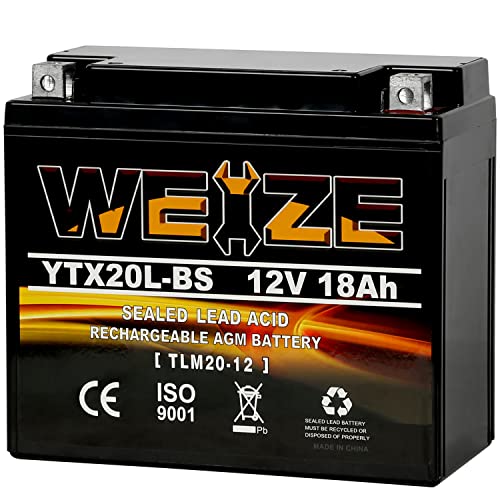
Weize YTX20L-BS Sealed AGM Battery ETX20L BS for Powersports
Goodyear GYTX16-12 AGM Battery 12V 18AH 240 CCA

Goodyear GYTX20HL AGM Battery 12V 22AH 310 CCA
Inside Each Recommended Option
The KMG YT12C is a sealed, maintenance-free 12V powersport battery built to slot directly into 1989-2004 Yamaha YFA-1 Breeze 125cc quads. Owners restoring a garage-kept Breeze that has sat for a season get a battery designed around that exact chassis, so terminal orientation and case dimensions match the stock tray without shimming or shimming brackets.
Lead-calcium chemistry is the quiet win here: it holds voltage on the shelf longer than conventional flooded cells, so a Breeze that only sees weekend trail duty still fires up after winter storage. The sealed case is also a practical upgrade over the older acid-vented designs, since you can mount it on its side without worrying about corrosion creeping onto your wiring harness.
Well-Handled Touches
- Maintenance-free sealed construction means no acid top-ups during routine care
- Lead-calcium plates retain charge through long storage periods, a real plus for seasonal riders
- Built to OEM form factor for the Breeze, so installation is essentially drop-in
- Vibration-resistant internal layout suits rutted trails and farm use
Worth Noting
- Specific CCA and amp-hour ratings are not published for this model, so cross-check against your old battery’s specs before ordering
- Older Breeze charging systems may need a voltage check; a weak stator can shorten any AGM’s life
Made For
Owners of 1989-2004 Yamaha YFA-1 Breeze 125cc quads who want a sealed, low-maintenance replacement that fits the factory tray.
Skip It When
The Mighty Max YTX7A-BS GEL is a better match for a Suzuki LTZ90 youth quad, where the published CCA and amp-hour ratings give you a clearer buying decision.
The VICI 12V 5Ah sealed lead-acid battery arrives with a wiring harness already attached, which removes the only awkward step in swapping a Razor MX125 Dirt Rocket pack. For parents dealing with a kids’ electric dirt bike that won’t hold a charge, the harness-matched terminals and compact 5Ah capacity restore ride time without a trip to the hardware store for connectors.
The trade-off is that this is a small-format replacement, not a performance upgrade. Expect similar run time and similar recharge behavior to the original factory pack, just with a fresh cell inside.
Notable Gains
- Pre-attached wiring harness cuts install time down to a few screws
- 12V 5Ah rating matches the original MX125 spec, so range feels familiar
- Sealed AGM construction is leak-resistant if the bike tips on a dirt mound
- Sized to also replace common 4.5Ah packs, giving some flexibility if you run other small electric ride-ons
Trade Offs
- Not a high-output upgrade; run time mirrors the original battery rather than extending it
- Small SLA cells benefit from being kept on a tender between rides to maximize lifespan
Right Fit For
Families with a Razor MX125 Dirt Rocket whose original battery no longer holds a charge and who want a plug-and-play swap.
Look Elsewhere When
The KMG YT12C is a more suitable pick for a vintage Yamaha Breeze 125cc, where a larger sealed AGM is the right form factor.
The Mighty Max YTX7A-BS GEL delivers a published 105 CCA at 12V with a 6Ah capacity, aimed squarely at the Suzuki LTZ90 youth quad and the LTR450 Quad Racer. GEL cells (where the electrolyte is suspended in a silica paste rather than absorbed in glass mat) typically self-discharge more slowly than standard AGM batteries, which matters when a quad sits for weeks between ride days.
For racers, the thick non-spillable gel paste is reassuring on rough tracks where vibration would slosh liquid around in a flooded cell. The temperature resilience also helps riders in regions with hot summers and cold shoulder seasons.
Advantages To Know
- 105 CCA is enough headroom for cold-morning starts on smaller quads
- GEL chemistry resists vibration, a real advantage on racetrack terrain
- Slow self-discharge rate keeps the battery ready through long storage gaps
- Sealed, non-spillable design tolerates angled mounting on modified chassis
Points To Keep In Mind
- 6Ah capacity is modest, so accessory loads (heated grips, light bars) drain it faster than a larger battery
- Specific charge-voltage parameters for GEL differ slightly from AGM, so confirm your charger has a GEL setting
Key Specs
Best Suited To
Owners of Suzuki LTZ90 and LTR450 quads who ride across seasons and want a vibration-resistant sealed battery.
Reach For A Different Pick When
The Goodyear GYTX20HL is a stronger match for a large touring motorcycle, where 310 CCA and 22Ah capacity handle bigger electrical demands.
The VMAX SLR125 ships as a two-pack of 12V 125Ah AGM deep-cycle batteries, aimed at RV solar banks, cabin off-grid systems, and wind-turbine storage rather than a starter application. Where a starter battery delivers a short, high-current burst, a deep-cycle unit is engineered for sustained discharge and recharge cycles over many hours, which is what solar arrays demand overnight.
VMAX rates the SLR line for an 8 to 10-year float-service lifespan and recombination capabilities that keep dangerous fumes out of enclosed battery boxes. That’s worth paying attention to if you’re venting your battery bay only loosely.
What Helps Most
- Two 125Ah units in series or parallel let you build a 24V bank or double your amp-hour reserve
- AGM sealed construction eliminates routine acid checks during off-grid deployments
- Float-service lifespan of 8 to 10 years under recommended charging conditions
- No dangerous fumes under normal operation, so mounting inside an RV bay is feasible with proper venting
Worth Noting
- At roughly 75 lbs each, the pair needs a solid mounting base and a plan for installation
- These are deep-cycle batteries, not high-CCA starter batteries; do not substitute them for a motorcycle application
Who It Suits Best
Cabin owners, RV enthusiasts, and small off-grid solar setups needing a deep-cycle AGM bank that can sit through partial charge cycles without quick degradation.
Swap It Out When
The WEIZE YTX20L-BS is a better fit for a motorcycle, ATV, or UTV, where its 300 CCA and starter-battery design actually match how the machine uses power.
The WEIZE YTX20HL-BS delivers 300 cold cranking amps at 12V with an 18Ah capacity, a combination that suits mid-to-large displacement motorcycles and many scooters with high-compression engines. The dimensions (roughly 6.88 x 3.42 x 6.1 inches) match a popular powersport case size, so the swap usually drops into the stock tray.
One detail worth weighing: this is a sealed AGM with the positive terminal on the right side as shipped. Always confirm polarity against your existing battery before bolting down, since reversing terminals can damage electronics.
Where It Helps
- 300 CCA handles cold starts on 800cc-and-up engines comfortably
- 18Ah capacity supports accessories like heated grips or auxiliary lights without immediate voltage sag
- Sealed AGM means no acid spills on a tip-over, an underrated safety upgrade
- Wide operating temperature range suits year-round riding schedules
A Few Limitations
- Listing ships the battery and screws only; no wire harness or mounting bracket is included
- Right-side positive polarity may not match every bike; verify before installation
Feature Snapshot
Perfect Match For
Riders of mid-to-large displacement motorcycles and touring scooters who want a sealed, no-maintenance battery with strong cranking performance.
Not Your Match When
The Weize YTX4L-BS is a smarter pick for a 50-125cc pit bike or scooter, where the smaller 3Ah capacity and 80 CCA rating align with the engine’s demands.
The Weize YTX4L-BS is a tiny 12V 3Ah AGM battery with 80 CCA, sized at roughly 4.45 x 2.72 x 3.54 inches. It’s the smallest unit in this roundup by a wide margin, and it’s designed for the engine bays of 50-125cc pit bikes, youth ATVs, and small scooters like the Honda NQ50 Spree.
Terminal layout (negative on the left, positive on the right) is standard for this form factor, and the leak-free sealed design means you don’t have to worry about acid creep if the bike rests on its side in a truck bed.
Practical Advantages
- Compact 3Ah capacity fits tight engine bays where larger batteries simply won’t seat
- 80 CCA is enough for small engines that don’t demand high cranking bursts
- Sealed, leak-free construction tolerates rough trail use and tip-overs
- Broad compatibility list covers Polaris Scrambler, Sportsman 90, Honda scooters, KLX110, DS70, and TTR125 models
Small Caveats
- 3Ah capacity is too small for accessories; rely on a battery tender if the bike sits unused for months
- Verify polarity against your existing battery; some pit bikes use reversed terminal layouts from the factory
Whose Shelf It Belongs On
Parents and pit-bike owners running 50-125cc engines, plus riders of small-displacement scooters who need a sealed battery that drops into a tight tray.
Where Another Pick Suits Better
The Mighty Max YTX7A-BS GEL handles bigger youth quads and racing applications, where the 6Ah capacity and 105 CCA give better headroom.
The Goodyear GYTX24HL tops the list on raw output, with 350 CCA and a 26Ah capacity at 12V. That combination targets big V-twin motorcycles, large touring bikes, and side-by-side UTVs where the starter motor pulls hard and the electrical system also feeds accessories like GPS units, audio, and lighting.
Sealed AGM construction means flexible mounting positions, and Goodyear rates the battery for high discharge rates and deep discharge recovery. The honest read is that this is overkill for a small scooter, but on a cold morning with a 1500cc engine, that extra cranking margin feels reassuring.
Where It Delivers
- 350 CCA is the highest figure in this list, an advantage on cold days and large engines
- 26Ah capacity supports touring loads like heated gear and accessory lighting
- Sealed design allows mounting in positions other than upright, except fully inverted
- Deep discharge recovery is helpful if a load accidentally drains the battery
Things To Consider
- Larger footprint means it won’t fit smaller battery trays, so always measure before ordering
- Premium spec comes with a higher weight class, which can matter on smaller machines where every pound counts
Core Details
Best Suited To
Riders of large V-twin cruisers, full-dress touring bikes, and UTV owners who want maximum cranking amps and accessory reserve.
Not Your Match When
The Goodyear GYTX16-12 fits mid-size motorcycles better, where 240 CCA and 18Ah capacity match the engine’s demands without the extra weight.
The Weize YTX20L-BS delivers 300 CCA and 18Ah capacity in a 12V sealed AGM package weighing about 12.8 lbs, fitting motorcycles, ATVs, UTVs, and snowmobiles. It’s listed as an ETX20L BS replacement, which is a common powersport form factor, so the swap is typically direct for owners of multiple vehicles who want to standardize on one battery type.
The published specs include an internal resistance of roughly 9.5 milliohms when fully charged. Lower internal resistance translates into more efficient current delivery during cranking, which is why specs like this matter when comparing similarly-rated batteries.
The Case For It
- 300 CCA pairs with 18Ah to cover most mid-to-large powersport engines comfortably
- Sealed AGM form factor is shared across many bike, ATV, and snowmobile models for standardized spares
- Around 12.8 lbs keeps weight manageable for trail machines
- Maintenance-free sealed design suits year-round use without acid top-ups
Practical Considerations
- Buyers should measure the existing battery and confirm terminal orientation before ordering, since reversed polarity damages electronics
- Snowmobile cold-soak conditions can strain any AGM; a battery tender pays for itself over multiple seasons
Right Fit For
Multi-vehicle owners who want one battery model that handles a motorcycle, an ATV, and a snowmobile without buying three different replacements.
A Better Fit Elsewhere
The Goodyear GYTX24HL is a stronger match for large touring motorcycles, where the 350 CCA and 26Ah capacity handle bigger electrical demands.
The Goodyear GYTX16-12 is a mid-spec 12V 18Ah AGM battery with 240 CCA, designed for sport bikes, standard motorcycles, ATVs, UTVs, 4-wheelers, snowmobiles, and personal watercraft. It sits a tier below the GYTX20HL in output, which keeps it from being the right call for the largest engines but makes it a natural match for mid-range applications.
For daily commuters and weekend trail riders, the high discharge rate and deep discharge recovery are the practical specs that translate into real ownership: a battery that bounces back from accessory drain without permanent capacity loss.
Why It Works Well
- 240 CCA is enough headroom for most 600-1000cc engines in normal climates
- 18Ah capacity supports standard accessory loads without rapid voltage drop
- Sealed SLA-AGM construction resists vibration and tolerates angled mounting
- Deep discharge recovery means occasional drain events don’t end the battery’s life
Some Limits To Know
- 240 CCA may feel modest on large V-twins in sub-freezing weather
- Verify case dimensions against your battery tray, since the GYTX16 footprint differs from the larger Goodyear units
Perfect Match For
Sport bike and standard motorcycle riders who commute year-round and want a sealed battery that balances output, capacity, and weight.
Where A Sibling Pick Shines
The Goodyear GYTX24HL is the better answer for big touring riders, where 350 CCA provides cold-weather margin that this 240 CCA unit can’t match.
The Goodyear GYTX20HL rounds out the list with a balanced profile: 310 CCA, 22Ah capacity, and sealed AGM construction in a form factor that fits many cruisers, touring bikes, ATVs, UTVs, scooters, and snowmobiles. It sits between the GYTX16 and the GYTX24HL in the Goodyear lineup, which is precisely why it works as a default pick for a wide range of riders.
The combination of high discharge rate and extended service life gives the GYTX20HL staying power across multiple riding seasons. For owners who want one battery that handles most jobs without overpaying for capacity they’ll never use, this is the practical sweet spot.
What Earns Its Place
- 310 CCA covers most mid-to-large displacement engines, including many V-twins in moderate climates
- 22Ah capacity balances accessory loads with reasonable weight
- Sealed AGM construction is flexible in mounting and resistant to vibration
- Extended service life under proper charging conditions keeps replacement cycles longer
Things To Weigh
- At 310 CCA, riders in extreme cold climates may still want to step up to the GYTX24HL
- Like every sealed AGM, it benefits from a smart charger or tender during long storage periods
Feature Card
Who Should Grab It
Cruiser and large touring riders who want a balanced sealed AGM that handles year-round riding and accessory loads without overpaying for unused capacity.
Consider Something Else When
The VMAX SLR125 pair is the right call for off-grid solar or RV banks, where deep-cycle design beats any starter battery in this list.
What To Weigh Before Picking Your Next Agm Bike Battery
Cold cranking amps (CCA) and amp-hour (Ah) capacity are the two numbers that actually drive fit. CCA measures how much current the battery delivers at 0°F for 30 seconds while staying above a minimum voltage, which matters most on cold mornings with a high-compression engine. Ah measures how much current the battery delivers over 20 hours, which matters for accessory loads and reserve capacity.
Match The Specs To The Machine, Not The Other Way Around
A 50cc scooter doesn’t need 300 CCA, and a 1500cc touring bike will struggle on 80 CCA. Read your owner’s manual for the recommended battery group size and CCA range, then pick a sealed AGM that lands inside that range. Terminal polarity matters too: reversed terminals on a sealed AGM can fry a bike’s rectifier before you finish the ride home.
Sealed AGM Versus Flooded Versus GEL
Sealed AGM (Absorbent Glass Mat) batteries suspend electrolyte in fiberglass mats, which is why they tolerate vibration, ship fully charged, and never need water. Flooded lead-acid batteries are cheaper upfront but vent gas and require periodic maintenance. GEL batteries use a silica-thickened paste, hold charge longer on the shelf, and handle deep discharge cycles better than standard AGM. If your bike sits for weeks between rides, AGM or GEL simplifies life. If you’re price-sensitive and don’t mind the upkeep, flooded cells remain a budget option.
Consider Climate And Storage Habits
Cold climates punish weak CCA ratings, while hot climates shorten battery life through electrolyte evaporation (less of an issue with sealed designs, but still relevant). Garage-kept bikes that only ride seasonally benefit from a battery tender, a small float charger that keeps the battery topped off without overcharging. Owners who ride daily can skip the tender and rely on the bike’s stator to do the work.
Key Considerations Across These Picks
Pitfalls Shoppers Hit
The most common mistake is choosing a battery by brand recognition alone, ignoring the CCA and Ah numbers that actually fit the engine. Another slip-up is assuming all YTX-prefixed batteries are interchangeable: YTX7A, YTX4L, YTX20L, and YTX24HL all refer to different case sizes and post configurations, so a “YTX” label doesn’t guarantee a drop-in fit. Cross-check the dimensions, terminal orientation, and CCA range against your old battery before clicking through to the listing.
When Paying More Pays Off
The jump from a budget sealed AGM to a premium unit typically buys higher CCA ratings, more amp-hour reserve, and longer published service life under float conditions. On a 600cc commuter bike, the difference may not show up for years. On a big V-twin touring rig with heated gear and accessory lighting, the extra capacity pays off every cold weekend when the engine fires immediately instead of clicking weakly.
Frequently Asked Questions
What Does AGM Stand For In A Bike Battery?
AGM stands for Absorbent Glass Mat, a design where the electrolyte is held in thin fiberglass mats between the lead plates. That construction makes the battery sealed, spill-resistant, and tolerant of vibration, which suits motorcycles, ATVs, and UTVs far better than a flooded cell.
How Long Does A Sealed AGM Bike Battery Usually Last?
Most sealed AGM powersport batteries last three to five years under regular riding and proper charging. Batteries kept on a tender between seasons often push past the five-year mark, while neglected batteries or those paired with weak charging systems can fail in under two seasons.
Can I Replace A Flooded Battery With A Sealed AGM?
In many cases, yes, as long as the new AGM matches the original battery’s group size, terminal orientation, and voltage. The charging system doesn’t need modification in most modern bikes, since alternators output voltages compatible with sealed AGM. Always confirm that your bike’s voltage regulator stays under roughly 14.4 volts during operation, which is the safe ceiling for AGM.
Do I Need A Special Charger For AGM Batteries?
A standard lead-acid charger works for basic maintenance, but a smart charger with an AGM setting delivers the correct absorption and float voltages. Using a charger that pushes too high a voltage can shorten AGM lifespan, especially on bikes left on a tender through winter.
Is A Higher CCA Rating Always Better?
Higher CCA gives more starting headroom in cold weather, but oversized CCA on a small engine doesn’t deliver meaningful benefit and just costs more. The honest trade-off is matching CCA to your engine size and climate, not chasing the highest number on the shelf.
Closing Remarks
The right AGM bike battery comes down to engine size, climate, and how you ride. Match the CCA and amp-hour numbers to the machine, double-check the case dimensions, and confirm terminal polarity before you click through. From a tiny YTX4L-BS for a pit bike to a 26Ah GYTX24HL for a full-dress tourer, the picks above cover the most common fits without overselling capacity you’ll never use.