A classic tractor that sits through winter, a golf cart that occasionally loses charge, a kid’s ride-on toy that’s been forgotten in the garage since last summer: these are the everyday 6V situations where a smart charger earns its keep. Most folks grab whatever fits the clamp size, only to discover the chemistry is wrong, or the amperage is too gentle to matter. The right pick comes down to matching battery type, amp draw, and maintenance needs to how you actually use the equipment.
The Main Contenders

NOCO GENIUS1 1A 6/12V Smart Battery Charger
NOCO GENIUS10 10A 6/12V Smart Battery Charger

NOCO GENIUS5 5A 6/12V Smart Battery Charger

Schumacher SC1323 4-in-1 15A Charger

Schumacher SC1355 1.5A Charger & Maintainer

Schumacher SC1308 6A 6V/12V Charger

SHARIVVY 6V Replacement Battery & Charger

Schumacher SC1361 6A 12V Charger & Starter

CRAFTSMAN CMXCESM258 12A 6V/12V Charger

Schumacher SC1281 6A Charger & 100A Starter
Inside Each Recommended Option
The GENIUS1 is the smallest unit in NOCO’s smart-charger family, and that’s the whole point. It hands you a 1-amp trickle (a low, steady current that tops off a battery without overcooking it) sized for batteries up to about 30 amp-hours, which means motorcycles, lawn tractors, classic cars in winter storage, and kids’ ride-on toys. The redesigned shell is roughly 35 percent smaller than the older G750 it replaced, so it tucks into a glove box or a shelf without crowding anything.
Compatibility covers flooded, gel, AGM (Absorbent Glass Mat, a sealed design where electrolyte is held in fiberglass mats), and deep-cycle lead-acid packs, plus lithium-ion LiFePO4 (Lithium Iron Phosphate, a common lithium chemistry prized for stability). Auto-detection picks 6V or 12V without you flipping a switch. Compared with the GENIUS5 reviewed later, this one trades raw speed for finesse, so plan on overnight charging for anything beyond a small engine.
The Value In It
- Tiny footprint fits cramped garages, motorcycle panniers, and shop drawers
- Multi-chemistry support means one charger handles flooded, AGM, gel, and LiFePO4
- Built-in desulfation (a pulse-recovery mode that breaks down sulfate crystal buildup on aging plates) helps recover lightly sulfated batteries that would otherwise sit dead
- Force Mode revives deeply discharged packs the protection circuit would normally reject
Things To Consider
- At 1 amp, large batteries (think 100+ Ah) take many hours to reach full charge
- Short clamp leads may require an extension for vehicles with buried battery terminals
Who It Suits Best
Anyone maintaining small batteries on motorcycles, ATVs, lawn equipment, or stored classics who values a compact unit over speed.
Where Another Pick Suits Better
The Schumacher SC1308 is a smarter call for folks who need diagnostic functions and a faster 6-amp delivery on the same budget.
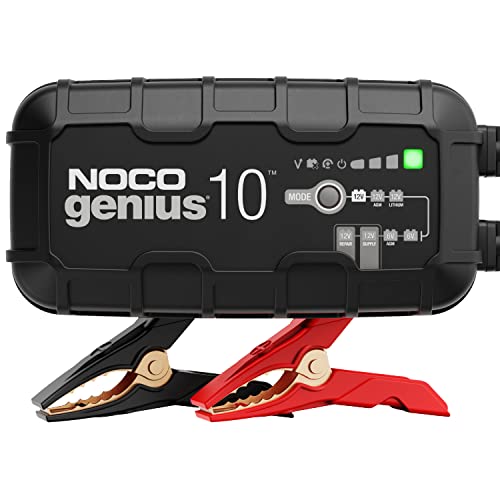
Step up to the GENIUS10 and the conversation shifts to serious recovery. The 10-amp output covers batteries up to 230 amp-hours, which puts full-size cars, trucks, boats, and RVs in play. The body is dramatically smaller than the G7200 it replaces, so the muscle doesn’t bring a brick-sized footprint with it.
Temperature compensation is the headline addition that separates this from the GENIUS5 and GENIUS1. The charger reads ambient conditions and adjusts voltage upward in cold weather, downward in heat, which prevents undercharge in winter and overcharge in a hot garage. Force Mode lets you wake a battery that’s dropped below the safety threshold the unit would otherwise refuse to touch. It’s overkill for a lawn tractor, but for a deep-cycle marine bank or a fleet truck, the headroom is genuine.
Real Benefits
- 10-amp output handles large automotive and marine banks without overnight waits
- Temperature-compensated charging adjusts for cold garages and summer heat
- Multi-stage profile (bulk, absorption, float, the stepped phases that refill, top off, and then hold a battery safely) extends service life on deep-cycle packs
- Overcharge protection and spark-proof clamps add real-world safety during hookup
- Compatible with LiFePO4 and lead-acid chemistries in one unit
Worth Noting
- Bulkier than the GENIUS1 and GENIUS5, less friendly to permanent shelf storage
- Higher power means more heat under heavy use; owners commonly report the case warms noticeably during long 10A cycles
- Premium price tier relative to smaller NOCO models in this list
Feature Snapshot
Made For
Owners of larger vehicles, marine batteries, or anyone maintaining deep-cycle banks who wants faster recovery than the smaller NOCO models offer.
Skip It When
The NOCO GENIUS1 is plenty for toys and small engines, and saves cash if your batteries stay under 30 amp-hours.
The GENIUS5 sits in the middle of NOCO’s lineup, and for many households that’s exactly the sweet spot. The 5-amp output handles batteries up to about 120 amp-hours, which covers most daily-driver cars and mid-sized marine applications without the wait times the GENIUS1 demands.
It’s roughly 65 percent smaller than the G3500 it replaces, so the form factor stays manageable on a workbench. The chemistry list matches its siblings: flooded, gel, AGM, deep-cycle, and lithium-ion LiFePO4. Auto-detection reads 6V or 12V, and the desulfation mode keeps stored batteries from slowly dying on the shelf. For someone with one car and one lawn tractor, this is usually the right tool, and stepping up only makes sense when the battery size justifies it.
Practical Pluses
- 5-amp rate splits the difference between slow trickle and full workshop muscle
- Wide chemistry support covers flooded, AGM, gel, and LiFePO4 in one box
- Compact housing stores easily in a trunk or under a workbench
- Maintenance mode can stay connected indefinitely without overcharging
Trade Offs
- Lacks temperature compensation that the GENIUS10 includes for extreme climates
- No dedicated engine-start function, unlike the Schumacher SC1281 or SC1323
Best Suited To
Daily drivers, mid-size marine use, and households maintaining a mix of vehicles where one charger needs to handle several sizes.
Consider Something Else When
The Schumacher SC1323 fits better when you also want an engine-start boost and 15 amps of recovery on larger trucks.
Schumacher’s SC1323 leans into workshop territory. The headline number is 15 amps, which is serious recovery speed for a depleted battery, plus a 3-amp maintenance mode for long-term storage. Built-in reverse-hookup protection means the unit simply won’t fire if you cross the cables, a small detail that prevents expensive mistakes on a busy bench.
The microprocessor (a small onboard chip that monitors voltage and adjusts charging stages automatically) manages the multi-stage profile, so you can leave it connected without babysitting. Auto voltage detection reads 6V or 12V and switches accordingly, which keeps the interface simple for users juggling different vehicles. Compared to the GENIUS10 reviewed earlier, this Schumacher trades NOCO’s compact form for raw amperage and broader vehicle coverage including RVs and marine batteries.
Strong Points
- 15-amp output recovers deeply discharged batteries faster than most competitors
- Multi-stage charging (a stepped process that adjusts voltage and current as the battery fills) extends battery life versus single-stage units
- Reverse-hookup protection prevents damage from clamp mistakes
- LED indicators give at-a-glance status without memorizing button sequences
Points To Note
- Bulkier than NOCO’s smaller units; not a glove-box companion
- Higher amperage means more heat buildup on long cycles, owners commonly report a warm case during extended 15A charging
- No dedicated lithium mode, limiting appeal for newer LiFePO4 setups
Key Product Details
Whose Shelf It Belongs On
Workshop owners and RV or marine enthusiasts who need raw amperage and fast turnaround on big batteries.
Reach For A Different Pick When
The NOCO GENIUS10 is a better match when you also maintain lithium batteries and want a more compact housing.
The SC1355 is the entry point into Schumacher’s 6V/12V lineup. The 1.5-amp rate is sized for small batteries, motorcycles, ATVs, and the seasonal toys that tend to sit dead over winter. It functions as a 3-in-1 device: charger, maintainer, and reconditioner, so a low-cost unit doesn’t mean a stripped feature list.
Compatibility runs across standard, AGM, and deep-cycle chemistries at 6V or 12V, and the microprocessor manages the profile automatically. It won’t crank a dead truck back to life, but for the kid’s Power Wheels-style ATV that gets parked all winter, this is a sensible, low-stakes tool. Compared with the SC1308 reviewed next, this one drops the diagnostic extras in favor of simpler controls and a friendlier price.
Noteworthy Benefits
- Low cost makes it easy to justify for toy batteries and seasonal equipment
- Recondition mode works to revive lightly sulfated batteries on small engines
- Auto voltage detection handles both 6V and 12V systems
- Compact size stores easily on a shelf or in a trailer
Points To Keep In Mind
- 1.5 amps is too slow for full-size automotive batteries that need real recovery
- No engine-start function, so it won’t help in a no-crank emergency
Right Fit For
Budget shoppers maintaining motorcycles, ATVs, lawn equipment, and similar small batteries who don’t need high amperage.
Look Elsewhere When
The SHARIVVY 6V battery and charger set is purpose-built if the goal is a full replacement battery for a specific ride-on toy.
The SC1308 earns its “6-in-1” label honestly. It combines a charger, maintainer, engine starter, battery tester, alternator tester, and desulfator in a single bench-friendly housing. For someone running a small shop or just tired of three separate tools cluttering the corner, this consolidation is the real pitch.
The 6-amp output lands between Schumacher’s 1.5-amp SC1355 and the 15-amp SC1323. Auto-detection covers 6V and 12V, and the multi-stage profile keeps batteries healthy through long winters. Compared with the GENIUS5 reviewed earlier, this Schumacher trades NOCO’s compactness for diagnostic functions and an engine-start boost that NOCO doesn’t offer at this tier.
Notable Gains
- Engine-start function adds emergency value beyond routine charging
- Alternator tester helps diagnose charging-system faults without a separate meter
- Multi-chemistry support handles standard, AGM, and deep-cycle batteries
- 6-amp rate balances speed with manageable heat on long sessions
Honest Caveats
- More functions mean more buttons; first-time users may need a manual to map the modes
- Bulkier than dedicated chargers in this list
- No LiFePO4-specific mode, limiting fit for newer lithium setups
Technical Highlights
Who Should Grab It
Shops, multi-vehicle households, and DIYers who want diagnostic functions alongside routine charging.
A Better Fit Elsewhere
The CRAFTSMAN CMXCESM258 suits you better if lithium compatibility and 12 amps of charging muscle are higher priorities than engine-start capability.
This is a different category of product entirely. Rather than a smart charger for vehicles, the SHARIVVY set is a sealed lead-acid battery plus matching charger built for kids’ ride-on toys: Motion Trendz, Mega Tredz, Yamaha YFZ-style replicas, and Disney-licensed racers. The battery is a 6-volt 4Ah sealed lead-acid unit with a white plug connector that matches common ride-on harnesses.
For households with a forgotten ride-on sitting in the garage, this is often the cleanest fix: replace the dead pack and you get a working toy again. Compare it to the Schumacher SC1355 reviewed earlier, which charges an existing battery but won’t replace one that’s truly failed. The trade-off is obvious: this product lives in a narrower niche.
Reasons It Performs
- Drop-in replacement for several common ride-on brands saves the frustration of hunting for a compatible battery
- Sealed lead-acid design is spill-resistant and safe in a child’s toy
- Matching charger included, so no separate purchase is required
- Compact form factor matches the small battery bays in ride-on vehicles
Softer Spots
- Limited to small ride-on applications; not useful for cars, motorcycles, or lawn equipment
- Connectors are toy-specific, so compatibility depends on your exact model
- Charging speed is modest given the small battery capacity
Perfect Match For
Parents replacing a dead battery in a kid’s ride-on toy and wanting a matched charger in the same box.
Swap It Out When
The Schumacher SC1355 is a smarter pick for anyone maintaining motorcycle or small-engine batteries rather than toys.
The SC1361 narrows the voltage range to 12V only, but it adds an engine-start function that the multi-voltage siblings don’t offer at this tier. In practical terms, this means it’s aimed squarely at 12V automotive, farm, and light equipment, where a dead battery means a stuck machine on a cold morning.
At 6 amps it handles the maintenance and slow-charge duties well, while the start function kicks in when you need a real crank. The microprocessor-managed profile protects the battery through long connections. For farms and workshops where 6V batteries are rare, this trades the versatility of the SC1308 for a sharper focus on 12V systems.
Everyday Wins
- Engine-start function adds emergency value beyond charging
- Compact housing is friendlier to shelf storage than larger Schumacher units
- Multi-stage profile helps extend battery service life
Where It Is Less Suited
- 12V-only design rules out classic 6V vehicles and golf carts
- Lower amperage than the SC1323, so large battery banks take longer
Built With In Mind
Farm and workshop users running 12V equipment who occasionally need an engine-start boost on a dead tractor or truck.
Another Choice May Suit
The SC1308 is the better call if you need both 6V and 12V support in one unit.
CRAFTSMAN’s CMXCESM258 brings 12 amps to a fully automatic package, with explicit lithium support that most Schumacher units in this list skip. The 4-in-1 design covers charger, maintainer, battery tester, and desulfator, and the chemistry list includes LiFePO4 alongside standard, AGM, and deep-cycle.
Auto-detection reads 6V or 12V, so the interface stays approachable. The 12-amp rate sits between the GENIUS10 and the SC1323 in raw output, while adding the lithium compatibility that newer vehicles increasingly need. Compared to the SC1308 reviewed earlier, this one trades some diagnostic extras for genuine LiFePO4 support and slightly higher amperage.
A Strong Showing
- 12-amp rate speeds recovery on larger batteries
- LiFePO4 compatibility suits newer vehicles and powersports lithium packs
- Multi-stage profile includes desulfation to recover lightly sulfated batteries
- Fully automatic operation simplifies routine maintenance
Potential Drawbacks
- No engine-start function, unlike the SC1281 or SC1323
- Battery chemistry list is broad but may still exclude some specialty types
Who Will Love This
Owners of modern vehicles and lithium-equipped powersports gear who need faster charging plus chemistry flexibility.
Not Your Match When
The Schumacher SC1281 fits better when engine-start capability matters more than lithium support.
The SC1281 headlines with a 100-amp engine-start boost, which puts it firmly in jump-starter territory alongside its charging duties. For trucks and SUVs that occasionally sit long enough to lose their charge, having the start function means a single tool handles the dead-morning scenario without calling for help.
The 6-amp charging rate handles routine maintenance and slow recovery, and the multi-stage profile keeps batteries healthy through long connections. Compared with the CRAFTSMAN reviewed just before, this Schumacher trades LiFePO4 compatibility for a much more powerful start function. It depends on whether you’d rather charge lithium or crank a stubborn V8.
Useful Strengths
- 100-amp engine start handles larger engines and stubborn batteries
- Multi-stage profile (bulk, absorption, float) protects battery health during long connections
- Auto voltage detection between 6V and 12V simplifies operation
Small Limitations
- No dedicated lithium mode, limiting fit for newer LiFePO4 setups
- Heavier and bulkier than chargers without the start function
Spec Overview
The Right Fit
Truck, SUV, and large-engine owners who want both maintenance charging and an emergency start boost in one tool.
Where A Sibling Pick Shines
The CRAFTSMAN CMXCESM258 is a smarter choice for lithium batteries and slightly faster routine charging.
Matching the Right Charger to Your Battery
Battery chemistry is the first decision point, and it’s where most people go wrong. Lead-acid comes in flooded (the traditional wet cells, requiring occasional top-offs), AGM (sealed and spill-resistant), gel (a gelled-electrolyte design sensitive to overvoltage), and deep-cycle variants built for repeated discharge. Lithium-ion LiFePO4 is a different animal with its own voltage profile, and using a charger without lithium support risks undercharging or tripping protection circuits. Match the chemistry to your battery before worrying about anything else.
Amperage is the second axis. A 1-amp trickle takes a full day to refill a mid-size car battery, while a 15-amp unit does the same job in a few hours. Small batteries (motorcycles, ATVs, toys) live happily at low amps; full automotive and marine banks benefit from the headroom. Choose based on the largest battery you realistically maintain, then keep the charger for everything smaller too. A unit that’s “too powerful” on a small battery generally just takes longer to drop to maintenance mode, which isn’t a problem.
Voltage detection matters more than it sounds. Many 6V batteries live in classic cars, golf carts, vintage tractors, and some ride-on toys, while nearly every modern car is 12V. Chargers with auto-detection handle both seamlessly, which removes the risk of feeding 12V into a 6V battery. Manual-switch units are cheaper but require attention every time you connect.
For long-term storage, a true maintenance mode is the difference between a battery that survives winter and one that doesn’t. Smart chargers drop to a float voltage (a low, steady holding voltage that offsets natural self-discharge without overcharging) once the battery is full, then trickle just enough to offset natural self-discharge. Leaving a non-maintaining charger connected for weeks will cook the fluid in flooded cells or stress lithium cells past safe limits.
Key Considerations Across These Picks
Mistakes Worth Dodging
The most common slip-up is buying on amperage alone. A 15-amp charger sounds impressive but is wasted money if your daily driver is a compact car with a small battery that only needs maintenance. Conversely, a 1-amp trickle is the wrong tool if you’re trying to recover a deeply discharged marine bank. Match the unit to the battery size, not the spec sheet bragging rights.
Chemistry mismatch is the second trap. Connecting a lead-acid-only charger to a LiFePO4 pack either undercharges the lithium cells or, worse, trips the battery’s protection circuit and leaves you with a brick that won’t take a charge. Always verify chemistry compatibility before purchase. The third is ignoring lead length and clamp design, which matters more than people expect in a cramped engine bay.
When Paying More Pays Off
The upgrade from entry-level to mid-tier usually buys temperature compensation, lithium support, and faster recovery on larger batteries. None of those matter if you maintain one small motorcycle battery, but for households juggling cars, trucks, and seasonal equipment, the extra capability pays back in fewer failed starts and longer battery life. Premium models add engine-start functions and diagnostic tools, which make sense for workshop users and less so for casual owners. The honest read is that spending up is worth it once you cross into multi-vehicle or specialty-chemistry territory.