A dead battery always seems to show up at the worst possible moment, whether it’s the lawn tractor after winter storage, the fishing boat at the dock, or the daily driver after a week of short trips. The right 5 amp charger handles all of it without overcooking the cells, and it doubles as a long-term maintainer when the vehicle sits for a stretch. This list rounds up ten solid options across marine, automotive, and multi-bank setups, so you can match a charger to your actual garage, driveway, or slip rather than guessing from a spec sheet.
Your Options, Compared
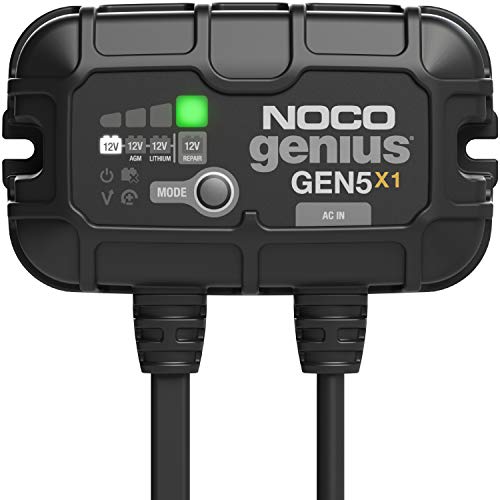
NOCO GEN5X1 12V 5A 1-Bank OnBoard Marine Battery Charger

Battery Tender Plus 4 Bank Multibank Charger 5 AMP
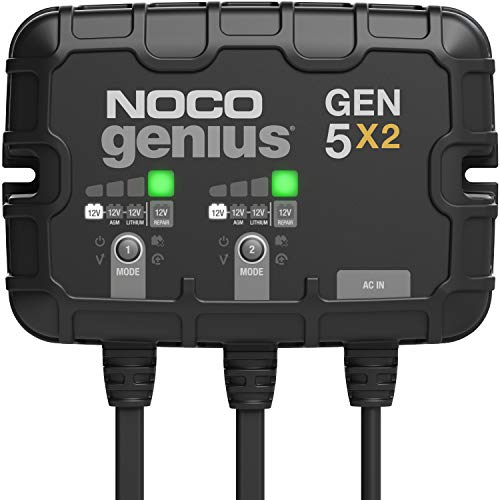
NOCO GEN5X2 12V 10A 2-Bank OnBoard Marine Battery Charger

Battery Tender 5 AMP 12V Battery Charger and Maintainer

NOCO GENPRO10X1 12V 10A 1-Bank OnBoard Marine Battery Charger

Schumacher Electric 1.5A Car Battery Charger & Maintainer SC1355

Schumacher Electric 6A Car Battery Charger & Maintainer SC1308

Schumacher Electric 6A Car Battery Charger & Maintainer SC1361

CRAFTSMAN 12A Car Battery Charger & Maintainer CMXCESM258

Schumacher Electric 6A Car Battery Charger & Maintainer SC1281
More On The Choices That Made The List
Slip-dock owners running a single 12-volt marine battery will appreciate how quietly this NOCO tucks into a bilge or under a console. The fully sealed, waterproof housing shrugs off spray and salt air, so it stays mounted year-round without you worrying about corrosion creeping into the case.
It accepts flooded, AGM, gel, and lithium (LiFePO₄) chemistries, which matters the moment you swap to a lithium house bank. Compared with the Battery Tender plus you’ll see later, this unit trades multi-bank flexibility for a tougher marine-grade shell, a sensible trade if your boat only runs one bank.
Where It Delivers
- Sealed waterproof housing tolerates direct marine exposure
- Supports lead-acid and lithium chemistries in the same unit
- Compact footprint fits tight bilge compartments
- Doubles as a maintenance charger for off-season storage
Things To Consider
- Single bank means no support for multi-battery boats
- Onboard install requires basic wiring comfort
Who It Suits Best
Anglers and weekend cruisers with one house bank who want a set-and-forget marine charger.
Where Another Pick Suits Better
Skippers running two banks should step up to the NOCO GEN5X2, which charges a house and start battery independently.
Households juggling a motorcycle, a lawn tractor, an ATV, and a classic car will feel the relief of four independent outputs in one box. Each bank delivers 1.25 amps, so you can leave everything plugged in over winter without one hungry battery starving the others.
The automatic switch from full charge to float mode (a low-voltage holding stage that prevents self-discharge) keeps each cell topped without overcooking it. The compact build means it tucks into a shelf in the garage, and the lightweight design makes it easy to relocate when you shuffle the vehicles around.
Strong Points
- Four isolated banks let you service multiple vehicles at once
- Smart float mode extends long-term battery life
- Works with standard, AGM, and lithium chemistries
- Lightweight enough to move between workbenches
Worth Noting
- Per-bank output is modest for very large batteries
- Not sealed for direct marine mounting
Made For
Multi-vehicle households that want one charger to maintain everything from a sports car to a snowmobile.
Consider Something Else When
Boaters needing a saltwater-rated build should look at the NOCO GEN5X1, which trades the extra banks for a sealed waterproof case.
Boats running both a starting battery and a house bank typically need two chargers or one bulky combiner. The GEN5X2 collapses that into a single sealed box rated IP68 (the international standard meaning dust-tight and submersible beyond splash exposure), splitting 10 amps into two independent 5-amp channels.
Temperature compensation adjusts the voltage curve for engine-room heat or cold morning launches, while overcharge protection catches the moment a battery reaches full so it can switch into maintenance mode. For boaters replacing an older 2-bank charger, the size reduction is immediately noticeable during install.
The Practical Payoff
- Charges two banks simultaneously without a combiner
- IP68 sealing handles bilge and splash exposure
- Temperature compensation adapts to engine-room heat
- Compatible with lead-acid and lithium chemistries
Room For Improvement
- Total output caps at 10 amps for both banks combined
- Higher output models suit very large house banks better
Best Suited To
Boat owners with a separate start and house bank who want one tidy onboard install.
A Better Fit Elsewhere
Single-battery boats save money with the NOCO GEN5X1, which dedicates all 5 amps to one bank instead of splitting it.
Daily drivers that sit for stretches, whether a backup SUV or a rarely used pickup, benefit from a true four-stage charging cycle (qualification, bulk, absorption, and float) that smart-charges without manual intervention. The unit specifically favors AGM batteries but accepts flooded, gel, and lithium chemistries as well.
Once the battery reaches full, the charger drops into float mode for as long as it’s plugged in, which is the kind of behavior that lets you wire it in and forget it for months. For most households, this is the dependable workhorse that earns its corner of the garage.
Real Benefits
- Four-stage charging protects AGM batteries from overcharge
- Float mode supports indefinite long-term connection
- Broad chemistry compatibility covers most vehicles
- Simple LED feedback for status at a glance
Points To Note
- Single-bank design means one battery at a time
- Not sealed for marine or outdoor mounting
Perfect Match For
Suburban households with a daily driver, SUV, or light truck that needs reliable topping off between trips.
Skip It When
Multi-vehicle owners should grab the Battery Tender Plus 4-Bank to maintain several batteries simultaneously.
Boats with larger house banks or RVs running a single deep-cycle bank often outgrow a 5-amp charger during recovery from a heavy discharge. The GENPRO10X1 doubles the output to 10 amps in a single bank, cutting charge times roughly in half compared with the GEN5X1.
The fully sealed, waterproof housing keeps it suited to marine and outdoor environments, and the re-engineered platform runs noticeably cooler than the older GEN1 it replaces. Owners commonly report quieter operation under sustained load, which matters in cabin spaces close to the charger.
Strengths Worth Knowing
- 10-amp output cuts recovery time on deep-cycle banks
- Waterproof sealed case suits marine installs
- Compatible with lead-acid and lithium batteries
- Improved thermal performance over previous generation
Trade-Offs
- Single-bank only, no support for two batteries
- Higher output makes it overkill for small motorcycle batteries
Whose Shelf It Belongs On
Boat and RV owners with a single large deep-cycle bank who want faster recovery without stepping up to multi-bank hardware.
Look Elsewhere When
Two-bank setups should pick the NOCO GEN5X2 instead, which dedicates 5 amps to each side independently.
Stored motorcycles, ATVs, and seasonal classics rarely need a heavy 5-amp bulk charge. They need a gentle, long-term float, and the SC1355 delivers that at 1.5 amps across both 6-volt and 12-volt systems.
The three-in-one design (charging, maintaining, and reconditioning mild sulfation) helps recover batteries that sat through a long winter. The recondition mode uses controlled pulse cycles to break down sulfate crystals on the plates, which is the most common cause of capacity loss in stored batteries.
The Value In It
- 6V and 12V compatibility covers powersports and classics
- Recondition mode helps recover stored batteries
- Low 1.5-amp output suits smaller battery capacities
- Compact size fits crowded garage shelves
Points To Keep In Mind
- Slow recovery on deeply discharged automotive batteries
- Single-bank only with no multi-battery support
Who Should Grab It
Powersports enthusiasts and classic-car owners wanting a gentle seasonal maintainer rather than a fast charger.
Reach For A Different Pick When
Drivers needing faster automotive recovery should consider the Battery Tender 5 AMP 12V unit, which delivers more current per hour.
Active home workshops often need more than a charger. They need diagnostics. The SC1308 crams six functions into one unit, including a 6V and 12V charger, maintainer, engine starter, battery tester, alternator tester, and a desulfator that pulses current through sulfated plates to restore capacity.
The alternator test function reads charging-system voltage while the engine runs, catching failing voltage regulators before they strand you. Compared with the smaller SC1355, you trade compactness for genuine diagnostic depth, and most DIYers find that tradeoff worthwhile.
What Makes Sense
- Six-in-one design reduces bench clutter
- Built-in alternator testing catches charging-system faults
- Desulfation mode helps recover older batteries
- Compatible with standard, AGM, and deep-cycle types
Honest Caveats
- Engine-start boost is modest for very large diesel engines
- More features mean a steeper learning curve for new users
The Right Fit
DIYers running an active home garage who want charging plus diagnostics in a single tool.
Not Your Match When
Boaters should skip this for the NOCO GEN5X2, which adds marine-grade waterproofing this Schumacher lacks.
Trucks, SUVs, and farm equipment that occasionally sit long enough to lose their crank benefit from a charger that doubles as a starting aid. The SC1361 charges, maintains, and supplies enough punch to start a stubborn engine, all from a 12V-focused platform.
The three-in-one design keeps the controls approachable for occasional use, and the durable build suits the rough treatment of a barn or workshop shelf. Compared with the SC1308 covered earlier, this unit trades diagnostic breadth for a more focused charging-plus-starting workflow.
Positive Points
- Engine-start assist rescues dead vehicles without a tow
- Durable construction suits farm and workshop environments
- Simple three-mode operation reduces setup guesswork
- Float-mode maintenance for long-term connection
Less-Strong Areas
- 12V-only design skips 6V classic-car batteries
- Single-bank output limits to one battery at a time
Built With In Mind
Truck owners, farmers, and rural drivers who need a reliable jump-style backup alongside a regular charger.
Swap It Out When
Classic-car owners running 6V systems should choose the Schumacher SC1308 instead, which supports both voltages.
Deeply discharged daily drivers come back faster with a charger that pushes harder. The CMXCESM258 delivers a 12-amp rapid charge mode alongside gentler 3-amp 12V and 2-amp 6V maintenance settings, covering everything from a quick recovery to a slow winter top-off.
Microprocessor-controlled charging automatically picks the right stage, so even users new to battery care get safe results. The four-in-one design (charger, maintainer, and desulfator across two voltages) makes it a flexible shop companion for mixed vehicle fleets.
A Favorable Mix
- 12-amp rapid mode shortens recovery time substantially
- 6V/12V compatibility spans most vehicle types
- Automatic microprocessor control prevents overcharging
- Includes LiFePO₄ support for modern lithium upgrades
Practical Considerations
- Bulkier form factor than dedicated maintainers
- Rapid mode generates more heat during long sessions
Who Will Love This
Garage hobbyists and multi-vehicle households needing fast top-ups alongside long-term maintenance in one tool.
Where A Sibling Pick Shines
Powersports users maintaining small batteries should grab the Schumacher SC1355, whose lower output suits delicate cells better.
Emergency roadside kits benefit from a charger that can also jump a dead battery without needing a second vehicle. The SC1281 pairs a 6-amp charging and maintenance cycle with a 100-amp engine-start boost, which is enough grunt to crank most passenger vehicles.
The fully automatic design picks the right stage without intervention, and the 6V/12V support covers classic cars alongside modern daily drivers. Most owners stash it in a trunk or garage shelf as both a maintainer and an insurance policy against a cold-morning no-start.
Why It Works Well
- 100-amp engine start rescues dead vehicles without a tow
- Fully automatic operation suits occasional users
- 6V and 12V compatibility covers most vehicle types
- Doubles as a long-term maintainer when not in rescue mode
Things To Weigh Up
- Bulkier than pure maintainers, less shelf-friendly
- Engine-start mode needs a nearby outlet for boost
Who Should Grab It
Commuters and rural drivers wanting an emergency-start backup with charging built in.
Another Choice May Suit
Workshop pros who already own a dedicated jump pack should pick the Schumacher SC1308 for its diagnostic tools instead.
What To Match Before You Pick A 5 Amp Charger
Charging Rate vs Battery Size
A 5-amp output hits a sweet spot for most 12V batteries in the 30 to 100 amp-hour range, which covers cars, SUVs, small boats, motorcycles, and lawn equipment. Smaller batteries like those in ATVs charge in a few hours, while larger deep-cycle marine banks can take 12 to 20 hours to refill fully. Mismatched chargers either overheat small batteries or take forever on big banks, so sizing matters more than the label on the box.
Battery Chemistry Compatibility
Modern chargers need to recognize multiple battery chemistries, including flooded (the traditional liquid-electrolyte lead-acid design), AGM (absorbent glass mat, where the electrolyte is held in fiberglass separators), gel (a thicker electrolyte that resists vibration), and increasingly lithium LiFePO₄. Lithium batteries need different voltage curves than lead-acid, so a charger without explicit lithium support can damage them over time.
Onboard vs Portable Mounting
Boats and RVs benefit from permanently mounted onboard chargers that stay sealed against moisture and run a multi-stage cycle whenever shore power is available. Portable garage chargers prioritize ease of connection and storage, since you move them between vehicles as needed. Pick the form factor that matches how the equipment actually lives.
Float and Maintenance Behavior
The best chargers don’t stop at full charge. They drop into a float stage (a low holding voltage that offsets natural self-discharge) so the battery can stay connected indefinitely without overcharging. Look for explicit float-mode behavior, especially for stored seasonal vehicles, because constant bulk charging slowly cooks a battery dry.
Diagnostic Extras Worth Considering
Engine-start assist, alternator testing, and desulfation modes (controlled pulses that break down lead-sulfate crystals on aging plates) extend a charger’s usefulness well beyond simple voltage delivery. For active workshops, these features justify stepping up to a multi-function unit, while occasional maintainers can skip them.
Marine-Grade Sealing
Any charger mounted in a bilge, engine room, or outdoor location needs an IP rating (Ingress Protection, an international standard rating dust and water resistance) of at least IP65, with IP68 preferred for sustained submersion. Garage-only chargers don’t need that level of sealing, which is why marine-rated units typically cost more per amp.
Key Considerations Across These Picks
Common Shopping Slip Ups
Plenty of shoppers grab a charger rated only for flooded lead-acid and then upgrade their boat or RV to lithium without checking compatibility. That’s a quiet way to shorten battery life over months of use. Another mistake is choosing an underpowered charger for a large deep-cycle bank, then assuming the battery is failing when it just needs more time. Always match the charger output to the battery’s amp-hour capacity, and double-check that the unit explicitly lists your chemistry.
Where The Extra Money Goes
Higher-tier models in this category invest in better sealing, independent multi-bank outputs, and smarter multi-stage charging curves. You also pay for diagnostic functions like alternator testing and desulfation modes that cheaper units skip. The premium is worth it for boats, RVs, and active workshops where the charger lives hard and needs to handle varied batteries. For a single garage-bound daily driver, a basic maintainer delivers everything you actually need without the extras.
Frequently Asked Questions
How Long Does A 5 Amp Charger Take To Recharge A Car Battery?
A typical 12V car battery around 50 amp-hours takes roughly 10 hours from a deeply discharged state, though smart chargers taper the rate as the battery fills. Maintenance charging on a partially full battery completes much faster.
Can A 5 Amp Charger Stay Connected All Winter?
Yes, provided it has an automatic float mode that drops to a holding voltage once the battery reaches full. Continuous bulk charging without float will eventually overheat and dry out the cells.
Do I Need A Special Charger For Lithium Batteries?
Lithium LiFePO₄ batteries need a charger with a chemistry setting or explicit lithium support. Lead-acid-only chargers can overcharge lithium cells, which causes permanent capacity loss.
Is A Higher Amp Charger Always Better?
Higher output shortens charge times on large batteries, but it can overheat smaller powersports batteries. Match the charger amperage to the battery size, and prioritize multi-stage control over raw output.
Can I Use A Marine Charger In My Garage?
Yes, marine chargers work fine in dry locations since they’re built tougher than garage units. The tradeoff is typically higher cost per amp because of the waterproof sealing you may not need.
Final Verdict
A 5 amp battery charger earns its space by being useful all year, not just during emergencies. The right pick depends on whether you need multi-bank flexibility, marine-grade sealing, or simple garage maintenance, and the ten options above cover each of those scenarios without overlap. Match the chemistry support, amp output, and form factor to your actual setup, and you’ll have a charger that quietly does its job for years.