Switching from lead-acid to a 48V lithium golf cart battery is one of the cleanest upgrades you can make to your cart. A modern LiFePO4 pack (lithium iron phosphate, the safest and longest-lasting lithium chemistry for deep-cycle use) drops a huge amount of weight off the frame, charges in a fraction of the time, and keeps delivering usable capacity for thousands of cycles while your old batteries sag after a few seasons. The challenge is sorting through similar-looking listings to find one that fits your motor, your charger, and the way you actually drive.
The nine kits below cover the full range of needs, from drop-in replacements for a stock Club Car or EZGO to higher-output packs built for hilly courses and longer weekends. Each one ships with the basics you need to get moving again, and the trade-offs are spelled out honestly so you can match the right battery to your cart, your terrain, and your tolerance for weight.
A Snapshot Of The Selections
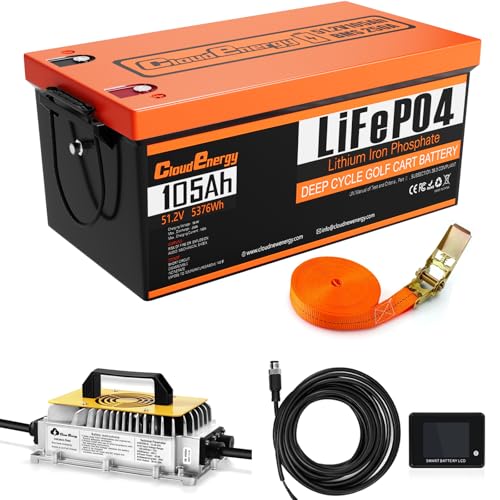
Cloudenergy 48V 105Ah LiFePO4 Lithium Golf Cart Battery

LOSSIGY 48V Lithium Battery Golf Cart Conversion Kit

Mehrpow 48V Lithium Battery Golf Cart Batteries Kit

OGRPHY 48V 105Ah Lithium Golf Cart Battery (Touch LCD)

KEZIMO 48V 105Ah Lithium Golf Cart Battery (APP)

DC HOUSE Metal Case 48V 100Ah Lithium Golf Cart Battery

OGRPHY 48V 105Ah Lithium Battery for Golf Carts and Solar

OGRPHY 48V 100Ah Lithium Battery with Onboard Charger

LOSSIGY 48V 100Ah Lithium Golf Cart Conversion Kit
A Breakdown Of The Leading Choices
The Cloudenergy kit lands in that sweet spot most cart owners actually want: a 48V, 105Ah LiFePO4 pack that arrives with a charger, a touch monitor, and a built-in 250A BMS (battery management system, the circuit board that protects cells from overcharge, over-discharge, and shorts). For a stock 48V cart used on flat pavement or a casual 18-hole loop, that combination covers the bases without forcing you into spec territory.
The retention strap is a small but appreciated touch that keeps the pack seated during spirited drives. Owners running a Club Car, EZGO, or similar stock setup with a moderate controller will likely find this drop-in experience straightforward. Compared with the higher-output OGRPHY options coming up, this one is less about peak bragging and more about reliable daily use.
Bright Spots
- Built-in 250A BMS protects the pack from overcharge, over-discharge, and short circuits, which matters for longevity more than most people realize.
- Touch monitor gives you a glanceable read on state of charge and voltage, so you can stop guessing how much range is left.
- Mobile app support means you can check on the battery from your phone, handy in a community cart fleet.
- Retention strap simplifies the install, especially helpful if you are swapping out old batteries for the first time.
Trade Offs
- The 250A continuous rating is fine for stock carts but may feel conservative for heavily modified builds or steep terrain.
- Some owners of older carts report needing an adapter or updated mounting bracket to seat the pack cleanly.
- As with most lithium packs, cold-weather capacity drops noticeably below freezing, so winter storage matters.
Who It Suits Best
Stock 48V golf carts used on flat ground or mild courses by owners who want a balanced, app-friendly swap-in.
Where Another Pick Suits Better
Owners chasing high peak output for steep hills or modified motors should consider the OGRPHY 200A BMS kit reviewed below instead.
LOSSIGY’s higher-capacity kit targets cart owners who feel hemmed in by standard 100Ah packs. The available 150Ah configuration gives you roughly 50 percent more usable energy than a 100Ah battery, which translates to longer range between charges and more headroom for accessories like lights, stereos, or a rear seat.
The conversion kit framing suggests this is meant as a full replacement for a bank of lead-acid batteries, and the included monitor helps track state of charge during those long days on the course. For property owners who use a cart as a utility vehicle on a large lot or farm, the extra capacity pays off in fewer interruptions. Against Cloudenergy’s lighter 105Ah option, this one trades some weight savings and physical footprint for range.
Positive Takeaways
- The 150Ah option delivers extended range, especially valuable for community carts running errands across large neighborhoods or resorts.
- Grade A prismatic LiFePO4 cells (rigid, brick-shaped cells that tend to last longer than soft-pouch alternatives) tend to hold up better in hot, enclosed battery compartments.
- Built-in BMS guards against the usual thermal and electrical faults that shorten lithium pack life.
- Monitor included in the kit removes the guesswork from state-of-charge readings.
Points To Note
- Higher-capacity packs add both weight and physical size, so you will want to confirm your battery tray dimensions before ordering.
- Charging takes longer than smaller packs unless you upgrade to a higher-amperage charger.
- Hazardous-materials shipping rules sometimes slow delivery and make returns more involved.
Feature Card
Made For
Long-range drivers using carts for full-day property work, large resort loops, or any setup where mid-day charging is inconvenient.
Consider Something Else When
Anyone with a tight battery tray should look at the smaller Mehrpow 100Ah kit reviewed below for an easier fit.
The Mehrpow kit is pitched at first-time lithium converters who want a clean, no-modification swap. Marketed as a one-time installation with no complicated wiring, it leans hard on plug-and-play simplicity, and that is genuinely the harder half of the upgrade for most weekend mechanics.
Inside, the pack uses 16 EVE-grade LiFePO4 cells (industry-standard prismatic cells from a well-known manufacturer), which explains the long cycle rating. Owners who have never touched a 48V system before will appreciate that this kit is less about tuning and more about getting back on the course. Side by side with Cloudenergy’s 105Ah option, this one keeps things simpler but skips the touch monitor and mobile app.
Useful Touches
- Plug-and-play design removes the wiring anxiety that puts many people off lithium conversions.
- Long cycle life rating means the pack should outlast several sets of lead-acid batteries before needing replacement.
- Balanced voltage across cells helps the pack age more evenly and hold capacity longer.
Things To Consider
- No onboard monitor or app integration, so you are checking voltage the old-fashioned way.
- Non-returnable due to shipping regulations, so double-check dimensions and connector type before ordering.
- Charging speed depends on the supplied charger, which is adequate but not particularly fast.
Feature Card
Right Fit For
First-time lithium upgraders who want the cleanest possible install without studying wiring diagrams for a weekend.
Look Elsewhere When
Anyone who wants real-time battery data on their phone will get more value from the KEZIMO kit reviewed below.
OGRPHY leans into the high-output side of this category, and the 200A BMS paired with that 1000A peak rating tells you exactly who this kit is for. Steep inclines, heavier passenger loads, and modified controllers all draw harder than a stock cart ever would, and this pack is built to absorb those surges without flinching.
You still get the same touch LCD monitor and 18A onboard charger that simplify daily ownership, plus the same UL-listed cell pedigree (UL certification is a third-party safety standard recognized across the battery industry) as the smaller Cloudenergy kit reviewed earlier. The honest read is that for flat-pavement users, the extra current headroom is overkill; for hilly-course owners, it is exactly what you need.
Where It Excels
- 200A continuous BMS output supports demanding controllers without tripping protection mid-climb.
- 1000A peak current (3 to 5 seconds) handles motor startup surges, especially under load.
- Touch LCD makes it easy to monitor voltage and state of charge at a glance.
- UL-certified grade A cells bring a third-party safety signal many buyers want to see.
Honest Caveats
- The 18A charger is convenient but slow for that capacity, so overnight charging is the realistic routine.
- Heavier than smaller BMS options, which can matter if your tray has tight weight margins.
Feature Card
Best Suited To
Cart owners running hilly courses or those who have upgraded controllers and need the headroom to match.
Skip It When
Flat-pavement users who would never tap that 1000A peak will do just as well with the Cloudenergy 250A BMS kit reviewed above.
KEZIMO takes the same 200A BMS platform that makes OGRPHY popular and wraps it in a slightly different feature mix aimed at the tech-comfortable owner. The mobile app and touch monitor combo lets you check battery health from your phone, which sounds small until you are storing the cart in a shed away from where you actually live.
The 105Ah capacity sits in the same range as the Cloudenergy kit, but the higher continuous discharge rating gives the KEZIMO pack more muscle during hill climbs. For owners who care about remote monitoring and clean reporting, this hits a useful middle ground. Compared with the OGRPHY 105Ah reviewed later, the difference is mostly in firmware and app polish.
Real Benefits
- Mobile app gives remote visibility into voltage, state of charge, and cell health.
- 200A continuous BMS handles moderate hill climbs without protection trips.
- Touch monitor keeps local readouts available even when the phone is not in hand.
- Lower self-discharge rate means less capacity loss during seasonal storage.
Things To Weigh
- App experience depends on the brand keeping firmware updated, which is a soft long-term consideration.
- Some owners report needing a Bluetooth connection to access the full readouts, which adds a step versus the touch monitor alone.
Who Should Grab It
Tech-comfortable owners who want both a physical monitor and a phone app for remote battery visibility.
A Better Fit Elsewhere
Anyone who values solar and off-grid crossover use should consider the OGRPHY 105AH Solar kit reviewed later in this list.
DC HOUSE differentiates itself with a metal enclosure rather than the plastic or aluminum cases most lithium packs ship in. For owners who store carts in uninsulated sheds, run them across gravel driveways, or deal with the occasional branch scrape, that extra layer of physical protection is genuinely useful.
The pack itself uses a 200A BMS with a 670A peak rating, slightly lower than the OGRPHY options, but the focus here is clearly on durability rather than maximum output. Bluetooth app monitoring and an LCD keep the smart features on par with the rest of this list. You may find this kit especially appealing if your cart lives outdoors and your old lead-acid box had rust scars by year three.
Strengths Worth Knowing
- Metal case provides stronger impact and abrasion resistance than typical plastic enclosures.
- Bluetooth mobile app pairs with an LCD monitor for both quick local checks and remote oversight.
- 18A onboard charger simplifies daily ownership without a separate purchase.
- Long cycle rating reduces the long-term replacement burden.
Points To Keep In Mind
- 670A peak is lower than some OGRPHY offerings, so heavily modified controllers may want more headroom.
- Metal enclosure adds weight compared with the lighter Cloudenergy kit reviewed earlier.
- Bluetooth signal can be flaky through thick metal garage walls in some installations.
Feature Card
Perfect Match For
Owners whose carts live outdoors, travel rough terrain, or have suffered case damage from older battery setups.
Another Choice May Suit
Those chasing the highest peak current numbers will find more headroom in the OGRPHY 200A BMS kit reviewed earlier.
This OGRPHY variant is positioned for owners who view their cart battery as part of a broader off-grid setup. The same 200A BMS and 1000A peak numbers carry over, but the explicit solar framing signals that the pack is meant to play nicely with charge controllers and inverter systems.
If you already have a solar array at the house, cabin, or workshop, this battery slots into that ecosystem more cleanly than a cart-only kit would. Owners running a small solar shed for lighting and tools will appreciate being able to swap a depleted cart pack into service as backup storage. Against the KEZIMO reviewed earlier, the difference is mostly about stated use case rather than core hardware.
What Works In Its Favor
- Solar compatibility means the pack can serve double duty as off-grid storage when not in the cart.
- 200A continuous BMS handles sustained loads from inverters without dropping out.
- Touch monitor and mobile app give you visibility regardless of where the pack is sitting.
- 4000-plus cycle rating supports years of daily cycling in solar service.
Less Ideal Details
- You will need a solar charge controller rated for LiFePO4 chemistry to actually use the solar capability, which is a separate purchase.
- As with other OGRPHY kits, the 18A charger is on the slow end for that capacity.
Built With In Mind
Off-grid property owners who already run a solar system and want a pack that can move between cart and cabin duty.
Reach For A Different Pick When
Cart-only owners without any solar infrastructure will get better value from the OGRPHY onboard-charger kit reviewed below.
This OGRPHY entry focuses on a different problem: daily charging without juggling external bricks. The 18A onboard charger is built into the kit, so the cart simply plugs into a standard outlet between rounds. For fleet operators, rental properties, and households where the cart gets used every day, that convenience adds up fast.
The 100Ah capacity is on the modest end of this list, but the cycle rating and BMS architecture match the more expensive siblings. Owners who only play a round or two a week may not need the onboard charging feature; anyone running a cart daily will appreciate how much simpler the routine becomes. Compared with the KEZIMO reviewed earlier, you lose the phone app but gain the integrated charger.
Standout Benefits
- Built-in 18A onboard charger removes the need to haul a separate charger in and out of storage.
- 5.12kWh capacity covers two to three rounds of golf on a single charge for most carts.
- 10.24kW peak output handles the typical stock motor without complaint.
- 5000-plus deep cycles support multi-year daily use.
Worth Bearing In Mind
- Onboard charging ties the pack to a specific cable length and outlet location.
- 100Ah is modest for users running accessories or longer utility sessions.
Feature Card
The Right Fit
Daily drivers, rental fleets, and anyone tired of wrestling a separate charger after every outing.
Swap It Out When
App-driven remote monitoring matters more than onboard charging, in which case the KEZIMO kit reviewed above is the stronger match.
The second LOSSIGY kit on the list shifts the focus from raw capacity to versatility. Listed for golf carts, solar systems, and RVs, this 100Ah 5.12kWh pack is built to move between roles, so a single battery can power your cart on Saturday and your camper or off-grid shed during the week.
The Bluetooth-enabled BMS is a real differentiator for owners who want to monitor state of charge from a phone. Compared with the heavier 150A LOSSIGY option reviewed earlier, this kit trades capacity for portability and crossover use. For a household or property with multiple energy needs, that flexibility is the actual selling point.
Strong Points
- Multi-use compatibility across cart, solar, and RV applications in a single pack.
- Bluetooth BMS lets you monitor voltage and health from a phone over a wireless connection.
- 200A continuous and 1000A peak handling covers the typical motor and inverter loads.
- Compact 100Ah form factor fits in tight battery trays and small enclosures.
Small Caveats
- No included monitor in this configuration, so you are relying on the Bluetooth app for readouts.
- 100Ah is the lower end of this list, which may feel tight for users with high accessory loads.
Whose Shelf It Belongs On
Garage multi-purpose owners who want one battery that can serve both cart duty and weekend solar or RV projects.
Where A Sibling Pick Shines
Cart-only owners wanting maximum range should look at the 150Ah LOSSIGY kit reviewed earlier in this list.
What Separates A Smart 48V Lithium Purchase From A Costly One
Capacity and BMS rating get most of the attention, but a few quieter attributes decide whether a 48V lithium golf cart battery ends up being a pleasure or a regret. Thinking through these before you order saves the hassle of returns, given how difficult hazmat-shipping logistics can make the process.
Match The Pack To Your Motor And Controller
Before anything else, confirm the continuous amp rating of your motor controller. Stock 48V cart controllers rarely pull more than 200A continuously, so a 200A BMS pack is plenty for most people. Modified or high-torque setups may benefit from the headroom of a 250A BMS like the Cloudenergy kit. Going oversized adds cost without much benefit; going undersized trips protection mid-climb.
Size And Weight Still Matter
A lithium pack can shave 200 to 300 pounds off your cart compared with a full set of lead-acid batteries, which improves braking, suspension wear, and turf friendliness. That said, dimensions still vary between kits, so a tape measure of your battery tray is a five-minute step worth taking. The DC HOUSE metal case reviewed above is heavier than most, which is great for stability but worth noting if your tray was sized for lighter packs.
Decide What Monitoring Style You Actually Want
Touch LCD monitors, mobile apps, and Bluetooth-only readouts each suit a different owner. People who charge in the garage where the cart lives will appreciate the glanceable LCD options. Owners storing carts away from their daily routine get more value from Bluetooth and app integration. The OGRPHY kits cover both ends of that spectrum across their product family, so the choice is more about your habits than the hardware itself.
Key Considerations Across These Picks
Common Shopping Slip Ups
The most frequent mistake is buying a pack sized for range without confirming it actually fits the battery tray. Lithium packs are often slightly larger than the lead-acid banks they replace, so measuring before ordering matters. Another common slip is underestimating the value of a smart BMS readout: a basic voltmeter still works, but owners consistently report that a touch monitor or app changes how they interact with the cart on a daily basis.
When Paying More Pays Off
Higher-tier kits in this list justify their cost with stronger BMS ratings, longer cycle ratings, and integrated features like onboard chargers and metal enclosures. For daily drivers and fleet operators, those extras pay back through convenience and longevity. For weekend recreational users with flat terrain, a mid-tier kit like the Mehrpow offers most of the upside without the extra spend.
Frequently Asked Questions
How long does a 48V lithium golf cart battery actually last?
Most LiFePO4 packs in this category are rated for 4,000 to 10,000 deep cycles, which translates to roughly 8 to 15 years of typical recreational use before noticeable capacity loss. Real-world lifespan depends heavily on depth of discharge and storage conditions.
Can I replace lead-acid batteries with lithium without changing my charger?
Most lithium kits ship with a compatible LiFePO4 charger, and using your old lead-acid charger is generally not recommended because the voltage profiles differ. Stick with the included or manufacturer-recommended charger to protect the BMS and cells.
Do lithium golf cart batteries work in cold weather?
LiFePO4 chemistry loses usable capacity below freezing, and charging below 32°F can damage cells. Owners in cold climates should store carts indoors during winter and avoid charging immediately after cold-soaking the pack.
What does the BMS actually protect against?
A BMS guards against overcharge, over-discharge, short circuits, and excessive current draw. It is the single biggest factor in long-term pack health, which is why matching its continuous amp rating to your motor controller matters.
Will a lithium battery fit my stock Club Car or EZGO?
Most 48V drop-in kits are designed to fit common cart models, but tray dimensions vary by year and configuration. Measuring your existing battery compartment and comparing it to the manufacturer’s published dimensions is the safest path before ordering.
The Takeaway
A quality 48V lithium golf cart battery pays for itself through lower weight, faster charging, and years of reliable cycling, and the nine kits above cover nearly every realistic use case from flat-pavement cruising to steep, off-grid property work. The right choice depends less on brand prestige and more on matching capacity, BMS rating, and monitoring features to the way you actually drive. Pick the kit that matches your terrain and your habits, and your cart will reward you with quieter, cleaner rounds for many seasons to come.