Pulling six or eight tired lead-acid batteries out of a golf cart bay is a chore nobody volunteers for twice. A lithium drop-in kit swaps that whole mess for one tidy box that weighs a fraction of the old pack, charges faster, and rides a golf cart further on every round. The catch is that not every kit plays nicely with every controller, and the spec sheet can look like alphabet soup on a first read.
This roundup walks through nine conversion kits built around LiFePO4 chemistry (lithium iron phosphate, the safest and longest-lasting lithium chemistry available for deep-cycle use). You will see real differences in BMS ratings (BMS = battery management system, the onboard circuit board that protects cells from overcharge, over-discharge, and shorts), continuous discharge current, peak surge capability, monitor features, and overall fit for different carts and driving habits. Each pick ties to a clear reader profile, from weekend course riders to off-grid solar setups running a utility cart.
The Picks In Brief
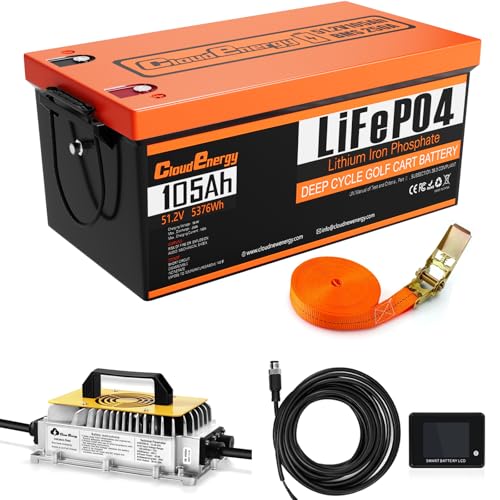
Cloudenergy 48V 105Ah LiFePO4 Golf Cart Battery

LOSSIGY 48V Lithium Golf Cart Conversion Kit

Mehrpow 48V 100Ah Golf Cart Battery Kit

OGRPHY 48V 105Ah Golf Cart Battery 200A BMS

KEZIMO 48V 105Ah Lithium Golf Cart Battery

DC HOUSE Metal Case 48V 100Ah Lithium Battery Kit

OGRPHY 48V 105Ah Lithium Battery Solar Friendly

OGRPHY 48V 100Ah Lithium Battery Onboard Charger

LOSSIGY 48V 100Ah Deep Cycle LiFePO4 Battery
The Details Behind The Selections
The Cloudenergy 48V 105Ah kit opens this list because it pairs a beefy 250A BMS with the kind of monitoring tools you usually see on pricier builds. A touch display sits up front for at-a-glance voltage and state-of-charge readings, while a mobile app pulls the same data to your phone over Bluetooth. The package includes a retention strap, which matters more than it sounds: lithium packs are far lighter than lead-acid banks, and an unsecured battery can shift on rough cart paths.
For most private-course owners who want plug-and-play convenience, this kit hits a comfortable middle ground. It is heavier on the feature side than the LOSSIGY entry below, though some riders may find the touch monitor and app combination more than they need.
Noteworthy Benefits
- 250A continuous BMS current supports demanding hill climbs and heavy passenger loads
- Touch monitor plus Bluetooth app lets you check state of charge without lifting the seat
- Included retention strap keeps the lighter lithium pack from shifting on rough terrain
- Drop-in form factor targets common 48V golf cart battery trays for straightforward installation
Things To Consider
- The higher BMS rating may be overkill for flat-ground neighborhood carts that never pull hard
- App connectivity relies on Bluetooth range, which can be spotty if your phone stays inside a clubhouse
Quick Facts
Who Will Love This
Tech-comfortable cart owners who appreciate live battery data and a strong BMS for hilly courses.
Look Elsewhere When
The Mehrpow 48V 100Ah Golf Cart Battery Kit is a better match for riders who prioritize maximum cycle life over smart features.
The LOSSIGY 48V Lithium Golf Cart Conversion Kit takes a different approach than the Cloudenergy kit above: it gives you a battery plus a matched charger plus a monitor in one bundle, and offers capacity variants so you can pick the size that matches your cart. For shoppers who want to spend less without giving up the basics of lithium chemistry, that combination is hard to beat.
The kit is aimed at practical upgraders who would rather plug in a single box than piece together separate components. If your driving stays moderate and your cart is a stock 48V model, this is a reasonable starting point.
The Practical Payoff
- All-in-one kit removes the guesswork of pairing a battery with a separate charger and monitor
- Available in multiple capacity options to suit different range needs
- Auto-grade cells target stable cycling for daily driving
Honest Caveats
- Source data is sparse on continuous current and peak output, so heavy-duty use cases are harder to confirm
- Limited monitoring sophistication compared with the touch-and-app kits elsewhere in this list
- Some riders report needing to verify the controller compatibility before installation
Best Suited To
First-time lithium upgraders who want a complete kit at a friendly entry point and moderate daily use.
A Better Fit Elsewhere
The OGRPHY 48V 105Ah Golf Cart Battery 200A BMS is the stronger pick for hilly neighborhoods that need a documented peak surge rating.
Cycle life is the Mehrpow 48V 100Ah Golf Cart Battery Kit’s headline number, and the manufacturer points to a deep-cycle claim that dwarfs traditional lead-acid packs. The kit ships from Mehrpow directly and arrives as a single replacement unit built around grade-A LiFePO4 cells. Owners of carts that see daily use, like resort fleets or rental properties, tend to value that kind of longevity the most.
One practical note: this item is non-returnable due to hazardous materials shipping regulations, so verifying your cart’s voltage and tray dimensions before ordering is essential.
Practical Advantages
- High deep-cycle rating for daily-discharge environments
- Plug-and-play design reduces installation complexity for most carts
- Grade-A cell construction supports stable long-term performance
- Single-pack form factor replaces a string of 6V or 8V lead-acid batteries cleanly
Trade Offs
- Non-returnable shipping means careful pre-purchase measurement is essential
- Hazardous-materials handling can extend delivery windows to some regions
Feature Snapshot
Right Fit For
Resort and rental fleet owners who rack up daily cycles and want maximum service life from a single drop-in pack.
Consider Something Else When
The Cloudenergy 48V 105Ah LiFePO4 Golf Cart Battery is a smarter fit for buyers who prioritize app-based monitoring alongside long life.
OGRPHY makes three different 48V kits on this list, and this one is the high-output version aimed at carts that climb real hills or carry four passengers up a steep driveway. The 200A BMS supports a published peak surge figure that gives the controller room to breathe during hard acceleration. A touch LCD monitor and an 18A charger come included, so the kit is genuinely complete out of the box.
It also doubles as a trolling motor battery for anglers running 48V setups on a jon boat, which adds versatility beyond the fairway.
Good Reasons To Consider
- 200A BMS supports demanding peak loads from stock and upgraded controllers
- Touch LCD monitor offers at-a-glance pack status without a phone
- Included 18A charger simplifies the path from box to first drive
- Dual-use compatibility with 48V trolling motor setups
Small Caveats
- Higher output comes with a heavier pack that may need careful tray fitting
- Troller/cart crossover use means verifying connector compatibility before installing
Built With In Mind
Hill-country cart owners and anglers running 48V trolling motors who want one battery that handles both jobs.
Swap It Out When
The OGRPHY 48V 100Ah Lithium Battery Onboard Charger is a smarter pick for owners who want an integrated onboard charger instead of an external 18A unit.
The KEZIMO 48V 105Ah Lithium Golf Cart Battery is the data-lover’s pick on this list, layering a touch monitor and a mobile app on top of a 200A BMS platform. Where the Cloudenergy kit uses a 250A BMS, KEZIMO leans on cell quality and monitoring to deliver the ownership experience. Sixteen A-grade LiFePO4 cells form the pack, and the BMS supports continuous discharge for hill climbs and rough terrain starts.
For cart owners who treat their battery as a piece of connected gear, the dual interface keeps you informed at the cart and from your phone.
Points In Its Favor
- Touch monitor and companion app provide redundant visibility into pack health
- 200A continuous discharge supports aggressive acceleration on steep terrain
- A-grade LiFePO4 cells target long service life across thousands of cycles
- Low self-discharge rate preserves capacity between weekend rounds
Things To Weigh
- Bluetooth pairing steps may frustrate shoppers who prefer simpler plug-and-play monitors
- Premium feature set typically sits above entry-level kit pricing
Feature Card
Whose Shelf It Belongs On
Connected-device enthusiasts who want both a touch screen at the cart and a phone app in their pocket.
Reach For A Different Pick When
The Cloudenergy 48V 105Ah LiFePO4 Golf Cart Battery is the stronger call for owners who prefer a higher 250A BMS ceiling over dual monitoring.
Most lithium conversion kits arrive in a plastic or sheet-metal enclosure, but the DC HOUSE Metal Case 48V 100Ah Lithium Battery Kit wraps its cells in a metal housing aimed at harsher environments. That matters on farms, hunting leases, and rough property roads where sticks, rocks, and temperature swings are part of daily life. The kit pairs that enclosure with a 200A BMS, Bluetooth app, an LCD monitor, and an 18A charger.
The manufacturer also claims a substantial weight reduction versus lead-acid banks, which lightens the cart’s front end and improves ride feel.
Strengths Worth Knowing
- Metal enclosure adds impact resistance for off-pavement use
- Full accessory bundle: 18A charger, LCD monitor, and Bluetooth app
- 200A BMS supports typical 48V controller demands
- Documented cycle life targets years of regular discharge cycles
Possible Compromises
- Metal case adds weight compared with plastic-enclosed lithium packs of similar capacity
- Bulkier form factor may not fit every stock battery tray without modification
Made For
Property owners and off-pavement riders who push carts through brush, gravel, and weather extremes.
Not Your Match When
The KEZIMO 48V 105Ah Lithium Golf Cart Battery is a better fit for fairway-only carts that prioritize monitoring features over rugged housing.
The OGRPHY 48V 105Ah Lithium Battery Solar Friendly version sits in the middle of OGRPHY’s 48V lineup, aimed squarely at off-grid setups where the cart shares garage space with a solar array. The 200A BMS, touch monitor, and mobile app mirror the company’s other 48V kit, while the chemistry is sized for both cart and stationary solar service. Compatibility with major golf cart controllers broadens its appeal across Club Car, EZGO, and Yamaha carts.
For property owners who want one battery that can be moved between a solar shed and a utility cart, this kit is genuinely versatile.
Where It Excels
- Dual-purpose design supports cart and stationary solar installations
- Wide controller compatibility covers the major 48V cart brands
- Touch monitor plus Bluetooth app provide full visibility in both use cases
- LiFePO4 chemistry supports thousands of cycles in deep-discharge service
Points To Note
- Solar compatibility requires a matched charge controller, which adds to total project cost
- Owners commonly report verifying charge profile settings on their inverter before first use
Perfect Match For
Off-grid homeowners and small-acreage owners running a solar system alongside a utility cart.
Where A Sibling Pick Shines
The OGRPHY 48V 105Ah Golf Cart Battery 200A BMS is a tighter match for pure cart owners who do not need solar tie-in.
The OGRPHY 48V 100Ah Lithium Battery Onboard Charger is the convenience pick of this roundup because it folds the charger into the battery itself. Owners plug a standard cord into the cart, and the onboard 18A LiFePO4 charger handles the rest. No external brick to mount, no extra wiring to chase through the cart body. The 200A BMS still supports demanding peak loads, and the published output figures line up with what most stock 48V controllers expect.
For homeowners who park the cart in a garage with a regular outlet, the onboard design removes a small but real daily annoyance.
Everyday Wins
- Integrated onboard charger removes the need for a separate external unit
- 200A BMS handles typical 48V controller demands with headroom
- Compact footprint preserves valuable battery tray space
- Single-cord charging simplifies garage or shed setup
Where It May Fall Short
- Onboard charger repairs require bench service rather than simple swap-out
- 100Ah capacity sits below the 105Ah kits above for maximum range
Key Attributes
Who Should Grab It
Cart owners who value simple plug-in charging and a tidy installation without a separate charger brick.
Skip It When
The LOSSIGY 48V Lithium Golf Cart Conversion Kit is a better budget fit for shoppers who want a complete bundle at a lower entry price.
The LOSSIGY 48V 100Ah Deep Cycle LiFePO4 Battery closes this list as the most versatile option, with explicit compatibility for solar systems and RVs alongside golf carts. The 200A Bluetooth BMS, peak surge rating, and 5.12kWh capacity make it a viable house battery for off-grid cabins and a reliable cart pack on weekends. The included charger and monitor round out the package.
For shoppers who want one battery that travels between roles, this kit earns its spot.
The Value In It
- Cross-compatibility with solar, RV, and golf cart use cases in one pack
- Bluetooth-enabled BMS adds connectivity beyond a basic monitor
- Auto-grade cells target stable cycling for deep-discharge service
Small Limitations
- Multi-role use means extra setup work for each new application
- Documentation focuses on general specs rather than cart-specific wiring guidance
Right Fit For
Off-grid enthusiasts and RV owners who also run a golf cart and want to share one battery platform.
Where Another Pick Suits Better
The OGRPHY 48V 100Ah Lithium Battery Onboard Charger is the cleaner cart-only solution with simpler installation.
What To Weigh Before Swapping Your Lead-Acid Bank
The first decision is voltage and capacity. A 48V system in a stock cart typically runs on a string of 6V or 8V lead-acid batteries, and the lithium replacement should match the original system’s nominal voltage closely. Capacity, measured in amp-hours (Ah), translates directly to range: a 100Ah pack at 48V stores roughly 5kWh of usable energy, which covers most 18-hole rounds with comfortable reserve.
The BMS rating matters more than most spec sheets suggest. The continuous discharge figure determines whether the pack can handle your controller’s peak demand during hill starts, while the peak surge figure covers short bursts like initial acceleration from a stop. For hilly courses or four-passenger carts, 200A or higher is a safer baseline.
Physical fit deserves a tape measure before checkout. Lithium packs save weight and space compared with lead-acid banks, but the tray dimensions and terminal placement still need to line up with your cart. Several kits on this list are non-returnable due to hazardous-materials regulations, which makes accurate measurement essential.
Finally, monitor your expectations on charging. A standard 18A charger refills a 100Ah lithium pack in roughly five to six hours, much faster than the all-night lead-acid routine. Owners commonly report charging after each use rather than waiting for a deep discharge, which keeps the pack in its happiest cycle range.
Key Considerations Across These Picks
Mistakes Worth Dodging
The biggest miss is assuming any 48V lithium pack will drop into any 48V cart. Controller compatibility, cable lengths, and tray dimensions vary by manufacturer and model year, and a mismatch can leave you stranded mid-install. Measuring the tray, photographing the existing wiring, and confirming the controller model before ordering saves the headache.
Another trap is ignoring the BMS rating. A cheaper 100A BMS may seem like a fair compromise, but on a hilly course or a cart that carries four passengers, that limit shows up fast as voltage sag or sudden power cutback mid-climb. Match the BMS to your real driving, not the spec that looks biggest on paper.
Where The Extra Money Goes
Higher-tier kits in this list earn their premium through monitoring, BMS headroom, and physical protection. Touch screens, Bluetooth apps, and metal enclosures are not fluff; they extend the useful life of the pack and give you real visibility into its health. Spending up makes sense for carts that see daily use, run hilly terrain, or double as solar storage, where the longer service life and better diagnostics pay back the difference over years, not months.