A dead battery rarely gives you a warning shot. It just hands you silence on a Monday morning, whether the ride is a daily commuter, a classic in winter storage, a motorcycle parked for the season, or a boat sitting at the dock. The right 12 volt battery charger turns that scenario from a tow-truck day into a quiet weekend task.
This lineup covers garage-friendly wall units, long-term storage maintainers, and portable lithium jump packs that double as power banks. Whether you’re protecting a fleet from sulfation (the slow buildup of lead sulfate crystals that weakens batteries over time), topping off a deep-cycle marine bank, or just keeping a lawn tractor alive through winter, there’s a fit below.
A Quick View Of The Lineup

CTEK 4.3 Test & Charge 12V Charger

BatteryMINDer 2012 12V Charger and Desulfator

Schumacher SL1674 1500A Lithium Jump Starter

NOCO GENIUS1 1A Smart Charger
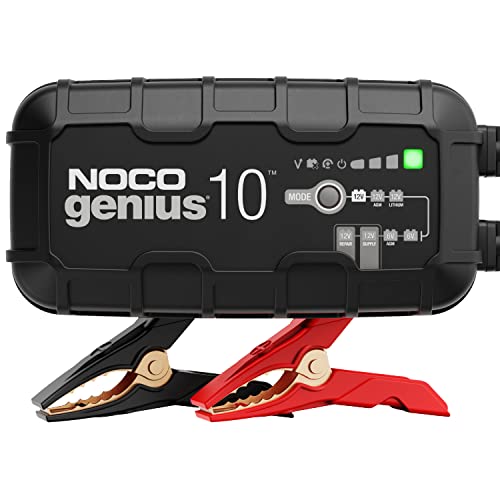
NOCO GENIUS10 10A Smart Charger

OPTIMA D1200+ Performance Charger

NOCO GENIUS5 5A Smart Charger

Schumacher SC1355 1.5A Charger Maintainer

Schumacher SC1280 15A Charger Maintainer

Schumacher SC1445 Wheeled Starter and Charger
The CTEK 4.3 earns its place for one practical reason: it does more than charge. It also tests the battery and the alternator, which means you can confirm whether a weak crank is the battery’s fault or the charging system’s. For a household that stores a convertible through November or only rides a motorcycle in warm months, that diagnostic layer pays for itself the first time it saves a parts run.
It runs fully automatic, with multi-stage charging that recovers, tops off, and then floats a battery without overcharging. Spark-free operation and reverse polarity protection (a safety feature that stops current if the clamps touch the wrong terminals) make it friendly in a tight garage, and the clean voltage output keeps modern vehicle electronics happy.
Where It Helps
- Built-in alternator test catches charging-system faults early
- Multi-stage program suits long winter storage on classic cars
- Spark-free clamps add confidence around fuel vapors
- Compact wall-mountable body fits small garage corners
Worth Noting
- 0.8 to 4.3A output means patience is required on deeply drained large batteries
- Premium pricing versus basic trickle units
Who Will Love This
Collectors and weekend drivers who want storage maintenance plus a quick health check on the charging system before spring.
A Better Fit Elsewhere
Roadside emergencies call for the Schumacher SL1674 1500A Lithium Jump Starter, which also acts as a power bank.
Where most chargers only push energy in, the BatteryMINDer 2012 works to remove what’s slowly killing the battery. Its high-frequency pulse desulfation sends tiny signals that dissolve lead sulfate crystals, the residue that builds up during long idle periods and short trips. That makes it a quiet favorite for RV owners, lawn tractor fleets, and anyone tired of replacing batteries that should still be serviceable.
The 2A output is gentle, but the unit runs full time without overcooking the battery, which is the whole point for storage duty. It handles a wide range of lead-acid chemistries commonly found in cars, motorcycles, and mowers.
A Favorable Mix
- Pulse desulfation can rescue batteries written off as dead
- Safe to leave connected through months of storage
- Works across flooded, AGM, and gel lead-acid types
Some Limits To Know
- 2A output is light work for charging large drained banks quickly
- Will not jump a battery that has dropped below usable voltage without patient recovery
Quick Facts
Perfect Match For
Owners of seasonal vehicles and deep-cycle banks who want to recover rather than replace tired batteries.
Not Your Match When
You need a fast turnaround on a dead vehicle, where the Schumacher SC1445 wheeled unit serves better.
The SL1674 lives in a glovebox, not on a shelf. Unlike the wall-bound CTEK and BatteryMINDer above, this is a portable lithium power pack that jumps a dead engine, then doubles as a phone and laptop charger on the road. The 10W wireless charging pad on top is a small but appreciated touch for road-trip cabins and camp chairs.
USB-A and USB-C fast ports cover modern devices, and the multi-mode LED flashlight adds a safety margin for late-night breakdowns. It is purpose-built for roadside emergencies rather than slow, steady maintenance.
Good Reasons To Consider
- 1500A peak output handles most cars and light trucks in a single crank
- Wireless charging pad is handy when outlets are scarce
- Compact lithium form factor fits under a seat
Practical Considerations
- Not a maintenance charger, it cannot sit on a battery for months
- Owners commonly report needing a top-up every few months if stored unused
Built With In Mind
Drivers who commute or travel through remote areas and want a backup that does more than one thing.
Look Elsewhere When
You need a wall unit to babysit a stored vehicle, where the NOCO GENIUS5 fits the long-term role.
The GENIUS1 is the smallest entry in the NOCO lineup, and that is its whole appeal. It handles 6V and 12V lead-acid batteries (including AGM, gel, flooded, and deep-cycle) plus lithium-ion LiFePO4 packs up to 30 amp-hours. For a motorcycle, a lawn tractor, or a small classic car, that is usually plenty.
It is fully automatic, includes overcharge protection, and runs a desulfation mode that can slowly revive a tired battery. The body is roughly the size of a paperback, so it tucks into a toolbox drawer without complaint.
What Works In Its Favor
- Charges both 6V and 12V plus LiFePO4 packs
- Tiny footprint suits cramped storage shelves
- Automatic multi-stage program prevents overcharging
Room For Improvement
- 1A output is slow on large or deeply discharged batteries
- 30Ah ceiling rules out bigger marine banks
Feature Snapshot
Right Fit For
Powersport owners and small-engine hobbyists who want a plug-and-forget unit on a workbench.
Skip It When
You run a deep-cycle marine bank; the NOCO GENIUS10 supports much larger capacity needs.
The GENIUS10 takes the GENIUS5’s proven formula and turns the dial up. At 10 amps, it charges deep-cycle marine banks, larger vehicle batteries, and powersport packs up to 230Ah far more quickly. A Force Mode pushes current into deeply discharged batteries that other chargers refuse to touch, which is genuinely useful on a cold January morning.
Temperature compensation adjusts voltage based on ambient conditions, so a hot garage or an uninsulated shed does not skew the charge. Across the lineup, this is the workhorse that bridges home use and small-shop duty.
What It Does Well
- 10A output finishes top-ups in a fraction of the GENIUS1’s time
- Force Mode revives zero-volt batteries that other chargers abandon
- Handles 6V, 12V lead-acid, and LiFePO4 chemistries
Honest Caveats
- Larger body than the GENIUS1 or GENIUS5, takes more bench space
- Force Mode requires care, watch temperature during extended use
Who Should Grab It
Drivers with larger vehicles, RV deep-cycles, or shop fleets that need fast turnaround and tough-chemistry coverage.
Reach For A Different Pick When
You only maintain a single lawn tractor, where the GENIUS1 is more wallet-friendly.
OPTIMA built its reputation on spiral-cell AGM batteries (Absorbent Glass Mat, where acid is held in fiberglass separators for better vibration resistance), and the D1200+ is the matched charger for that chemistry. It uses a hybrid profile that balances charging speed with battery health, which matters for the premium cells OPTIMA puts in trucks, muscle cars, and overland builds.
The included quick-connect cable assemblies (clamps and ring terminals) swap in seconds, and the wall organizer bracket keeps the unit off the floor. Owners commonly report the bundled setup encouraging routine use rather than “I’ll get to it later” garage clutter.
The Practical Payoff
- Quick-connect harness speeds swaps between vehicles
- Wall bracket keeps cords tidy in a working garage
- Matched for OPTIMA AGM cells, ideal for premium setups
Trade-Offs
- Premium pricing versus general-purpose smart chargers
- Brand-specific tuning shines most with matching OPTIMA batteries
Made For
Garages running OPTIMA batteries and owners who value a tidy, wall-mounted charging station.
Swap It Out When
You maintain a mixed fleet of batteries; the NOCO GENIUS10 covers broader chemistries at a friendlier cost.
The GENIUS5 is the middle child of the NOCO family, and for many households, it is the right one. It supports 6V and 12V lead-acid (AGM, gel, flooded, deep-cycle) plus LiFePO4 batteries up to 120Ah, with a 5A output that finishes a typical car top-up overnight without overstaying its welcome. It can also repair batteries through desulfation and recover deeply discharged units.
Compared to the GENIUS1 above, it cuts charge times dramatically on the same battery. Compared to the GENIUS10, it asks for less bench space and less money.
Advantages To Know
- 5A output strikes a useful middle ground for daily drivers
- Temperature compensation adjusts voltage for hot and cold shops
- Compact body fits on a shelf with room to spare
Things To Consider
- Slower than the GENIUS10 on large deep-cycle banks
- Lacks the Force Mode of its bigger sibling for fully dead batteries
Feature Rundown
The Right Fit
Daily drivers and small-shop owners who want one charger that handles both maintenance and recovery tasks.
Where Another Pick Suits Better
Storage-only collectors get more value from the BatteryMINDer 2012 with its dedicated desulfation program.
The SC1355 is the entry-level Schumacher for people who want a do-it-all trickle charger without spending much. It covers 6V and 12V batteries, including standard, AGM, and deep-cycle types, charging, maintaining, and reconditioning in one automatic package. The 1.5A output is gentle, but the reconditioning mode is where it earns its keep.
For a budget-conscious shopper storing a single car, ATV, or motorcycle, this is enough. Compared to the smarter NOCO units above, it offers fewer chemistry-specific profiles, which is the trade-off for the lower cost.
Benefits That Matter
- Affordable price point for first-time owners
- Reconditioning mode helps recover neglected batteries
- Microprocessor-controlled charging adjusts as the battery fills
Potential Drawbacks
- 1.5A output is slow on anything larger than a car battery
- No dedicated lithium profile for LiFePO4 conversions
Whose Shelf It Belongs On
Budget-conscious owners maintaining a single car, motorcycle, or ATV through short storage windows.
Another Choice May Suit
You maintain multiple vehicles, where the NOCO GENIUS5 covers more chemistries for only slightly more.
The SC1280 delivers noticeably more charging muscle than the SC1355 above. With microprocessor-controlled 4-in-1 charging, it charges, maintains, tests, and restores 6V and 12V batteries across automotive, marine, and powersport types. A 15A peak rate helps revive batteries that have been deeply discharged through a winter or a forgotten accessory tap.
Its 3A trickle rate keeps the maintenance role intact for long connects. This is a flexible unit for households juggling a daily driver, a boat, and a few weekend toys.
Everyday Wins
- 15A peak current handles larger batteries with confidence
- Multi-stage restore mode helps recover deeply discharged packs
- Works across auto, marine, AGM, gel, and deep-cycle types
Factors To Consider
- Larger chassis than the smaller Schumacher units
- Higher amp output demands a heavier gauge cord, which limits portability
Best Suited To
Multi-vehicle households and boat owners who want one charger that handles car and marine duty reliably.
Consider Something Else When
Your only need is a small garage trickle charger; the Schumacher SC1355 covers basic duty at lower cost.
The SC1445 is the garage heavyweight of the lineup. On wheels with a 250A engine start mode, it pushes enough current to crank stubborn V8s and diesels that a wall charger cannot touch. A 10A charging mode handles the slower top-up role once the engine is back on its feet.
It supports 6V and 12V systems, manual operation, and the kind of build that lives on a workshop floor rather than a shelf. This is the right pick for small shops and serious DIYers, less so for a one-car apartment.
What Helps Most
- 250A engine start restarts stubborn gas and diesel engines
- Wheeled chassis moves easily between bays
- 10A charging handles top-ups between starts
Where It May Fall Short
- Bulky form factor rules it out for small apartments
- Manual operation demands more attention than automatic units
Right Fit For
Small shop owners and fleet operators who restart large engines often and need start-and-charge capability in one box.
Where Another Pick Suits Better
Daily commuters get all the help they need from the NOCO GENIUS5 without the workshop footprint.
## What To Weigh Before Buying a 12 Volt Battery Charger### Match The Charger To The Battery And The ScheduleBattery chemistry is the first filter. Standard flooded, AGM, gel, and lithium LiFePO4 each prefer a different voltage curve, and a mismatched profile will shorten life. Riders, classic-car collectors, and RV owners usually want multi-chemistry support because fleets are rarely uniform. The NOCO GENIUS5 and GENIUS10 are strong examples of chargers that span chemistries.### Match The Output To The Battery SizeAmp rating matters as much as chemistry. A 1A to 2A trickle charger is enough for motorcycle and lawn tractor batteries, but a 100Ah marine bank will sit there all week at that rate. The NOCO GENIUS10 at 10A and the Schumacher SC1280 at 15A shorten that timeline meaningfully. Larger banks want higher amps; small batteries prefer gentle ones.### Match The Form Factor To The LocationWall-mounted units like the CTEK 4.3 and OPTIMA D1200+ suit permanent garage setups. Portable lithium jump packs like the Schumacher SL1674 fit trunks and travel bags. Wheeled starters live in workshops where size is not a constraint. Picking the right shape early avoids rebuying later.### Decide Between Maintenance And RecoveryStorage-only vehicles benefit from maintainers with desulfation, such as the BatteryMINDer 2012. Active daily drivers need faster top-ups, where the NOCO GENIUS10 or Schumacher SC1280 earn their keep. Heavy diesels and neglected trucks eventually need a wheeled starter like the SC1445.## Key Considerations Across These Picks### Where Shoppers Go WrongThe most common mistake is matching a charger to the wrong chemistry, then blaming the battery when it sulfates early. Buyers also frequently underestimate the difference between a 1.5A trickle and a 10A smart charger on a deeply discharged battery; patience runs out long before the battery is full. Plan for output at least twice what you think you’ll need.### When Paying More Pays OffHigher-tier models in this category add diagnostic testing (CTEK 4.3), matched AGM profiles (OPTIMA D1200+), faster recovery (GENIUS10), and workshop-grade starting power (SC1445). Those features earn their keep when you maintain premium cells, manage multiple vehicles, or restart large engines. For a single commuter car on a shelf, a budget trickle unit is usually enough.