Swapping a heavy lead-acid pack for a lithium upgrade is one of the quietest improvements you can make to an RV, boat, or off-grid setup. A quality 12V 100Ah LiFePO4 (lithium iron phosphate, the safest common lithium chemistry) pack shaves serious weight, holds far more usable energy, and keeps delivering through thousands of cycles without the slow death spiral of flooded cells.
The ten options below cover the cases that come up most: solo RV installs, paired trolling motor banks, cold-climate builds, and setups where the charger matters just as much as the battery. Group 31 and Group 24 footprints both show up, so check your battery tray before you commit.
Your Options, Compared

Redodo 12V 100Ah LiFePO4 Battery, Group 31, Bluetooth
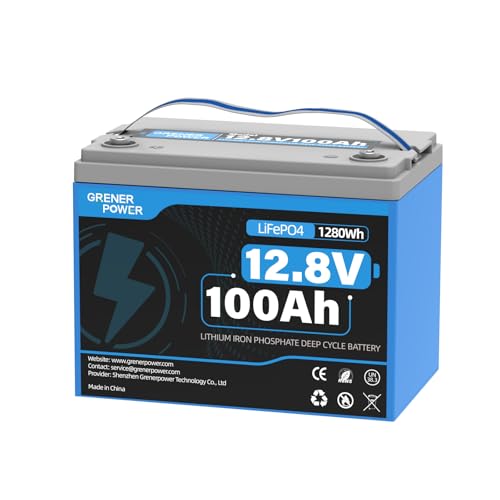
GrenerPower 12V 100Ah LiFePO4 Battery, Group 24

Redodo 12V 100Ah LiFePO4 Battery, Group 31

Redodo 2 Pack 12V 100Ah Trolling Motor LiFePO4 Battery

Redodo 12V 100Ah RV LiFePO4 Battery, Group 31, Bluetooth

Redodo 12V 100Ah Marine LiFePO4 Battery, Group 31

Redodo 2 Pack 12V 100Ah RV Lithium Battery, Group 31

Redodo 12V 100Ah LiFePO4 RV Battery, Group 31, 1280Wh

Redodo 12.8V 100Ah LiFePO4 Battery with 14.6V 10A Charger

power queen 12V 100Ah LiFePO4 Battery, Group 31
More Details On Our Top Picks
The first Redodo on this list earns its spot by adding Bluetooth 5.0 on top of a standard Group 31 LiFePO4 cell, so you can pull up voltage, current, and remaining capacity from a phone without opening a compartment. Compared with the no-frills Redodo Group 31 battery later in this list, this one trades a bit of cost for genuine visibility into state of charge.
For RV owners who run a fridge, lights, and a water pump off one house bank, that real-time read takes the guesswork out of trip planning. In our view, the Bluetooth layer earns its keep on longer excursions where solar input shifts hour by hour.
Notable Gains
- Bluetooth 5.0 app shows voltage, current, power, and remaining capacity at a glance
- Remote power-off from the app helps if you forget to flip a switch at the campsite
- Cold-weather charge cutoff halts charging below 32°F, protecting the cells in shoulder-season trips
- Standard Group 31 footprint drops into most RV and marine battery trays without modification
Things To Consider
- The Bluetooth radio draws a small standby current, so storage without periodic top-ups can drain the pack slowly
- App-dependent owners should confirm their phone stays compatible over time before relying on it as the primary monitor
Key Product Details
Right Fit For
RV owners who want app-based monitoring and camp in climates that dip below freezing overnight.
Look Elsewhere When
The power queen 12V 100Ah LiFePO4 Battery, Group 31 is a better fit for shoppers who want a straightforward Group 31 pack without paying extra for Bluetooth.
Where most of the Redodo lineup sits in a Group 31 case, the GrenerPower pack uses the shorter Group 24 footprint, which matters more than people expect on smaller boats and compact camper installs. The trade-off shows up in internal cell layout, and GrenerPower fills the space with cylindrical Grade A+ cells arranged around a 100A BMS (battery management system, the protection circuit that prevents overcharge, overdischarge, and shorts).
That 100A BMS is the headline spec here. It covers overcharge, overdischarge, short-circuit, overcurrent, and overheat events in a five-layer protection scheme, which is more layers than most entry-level packs document. For home backup, RV outlets, or a trolling motor that occasionally pulls hard, that headroom is genuinely useful.
Bright Spots
- Group 24 form factor slots into smaller battery trays where Group 31 simply will not clear the lid
- Five-layer BMS protection covers the common failure modes most shoppers worry about
- Cylindrical Grade A+ cells are easier for the manufacturer to match and balance than prismatic alternatives
- LiFePO4 chemistry avoids thermal runaway risk associated with other lithium types
Worth Noting
- Group 24 packs sometimes require a spacer or shim when replacing larger lead-acid batteries in trays designed for Group 27 or 31
- Owners should confirm charger compatibility, since older lead-acid chargers can misread a lithium profile
Made For
Boat and RV owners with tight battery compartments who want serious protection circuitry in a compact case.
Not Your Match When
The Redodo 12V 100Ah LiFePO4 Battery, Group 31 (pick 1 or pick 3) is a better fit for installations that need the longer Group 31 footprint.
This is the no-nonsense Redodo, the same Group 31 case as the Bluetooth version but stripped down to the essentials. The honest read is that most owners don’t need an app to read voltage once they install a shunt or a basic monitor, and the money saved here goes straight into the cells.
For RV owners on a tighter budget who already plan to add a separate battery monitor, this is the practical starting point. It uses the same automotive-grade LiFePO4 cell family as the rest of the Redodo lineup, just without the Bluetooth radio on top.
Where It Helps
- Automotive-grade LiFePO4 cells are documented for thousands of deep cycles
- Group 31 case matches common RV trays, simplifying the swap from lead-acid
- Lower self-discharge rate than lead-acid, so it holds a charge through off-season storage better
Honest Caveats
- No integrated monitoring means you rely on a separate gauge or shunt for accurate state-of-charge readings
- No low-temperature charging protection listed in the source spec, so winter charging needs manual management
Best Suited To
Shoppers who want a straightforward Group 31 LiFePO4 battery and already plan to monitor it externally.
Reach For A Different Pick When
The Redodo 12V 100Ah LiFePO4 Battery, Group 31, Bluetooth (pick 1) is a better fit for cold-climate owners who want built-in cutoff logic and app-based monitoring.
Most trolling motors run on 24V or 36V systems, which means wiring two or three batteries in series, and matching cells matters when they share a long cable run. This Redodo bundle ships two identical 100Ah packs so the internal resistance stays balanced from day one.
Boaters who run a 24V trolling motor on a bass boat or jon boat get a turnkey 200Ah bank at 24V without sourcing matched packs separately. The dual-pack shipping is also a subtle bonus for owners who don’t want to gamble on cells from two different production batches behaving differently over time.
What Helps Most
- Two matched packs delivered together keep internal resistance similar, which extends series-bank lifespan
- 100Ah per pack means a 24V trolling motor draws from a 200Ah bank with usable capacity well above lead-acid equivalents
- Group 31 form factor simplifies mounting in standard marine trays
Points To Note
- Heavier and bulkier than a single-pack solution, so smaller skiffs may need to check weight and tray space
- Series wiring requires careful attention to cable gauge and fuse placement, which adds installation steps
Who It Suits Best
Boat owners running a 24V trolling motor who want matched batteries delivered as a single purchase.
Consider Something Else When
The Redodo 12V 100Ah LiFePO4 Battery, Group 31 (pick 3) is a better fit for solo 12V installations that don’t need a series bank.
The newer “Next-Gen” RV-focused Redodo shares the Group 31 footprint and Bluetooth 5.0 radio as pick 1, but positions itself specifically for RV house banks. That matters because RV walls, slide-outs, and tight compartments all influence how a battery behaves thermally during charging.
For full-time RVers who camp through fall and early spring, the cold-weather cutoff below 0°C is the headline feature. In our view, it makes the most sense as a one-for-one swap for an AGM house battery where you already know the layout works.
Useful Touches
- Bluetooth app shows voltage, current, and capacity in real time without opening a panel
- Charging halts below 0°C, which protects the cells during shoulder-season RV trips
- Remote power-off feature prevents the “dead battery panic” if you leave something running
Some Limits To Know
- RV-specific marketing doesn’t change the cell chemistry, so it overlaps heavily with pick 1
- Bluetooth adds minor standby draw, so long storage should still include a maintenance charge schedule
Perfect Match For
Full-time or four-season RVers who want app visibility and cold-weather charging protection in a Group 31 case.
Swap It Out When
The Redodo 12V 100Ah LiFePO4 Battery, Group 31 (pick 3) is a better fit for RV owners who don’t need Bluetooth or cold cutoff and want to keep things simple.
This marine-targeted Redodo leans into EV-grade LiFePO4 cells, which is a meaningful upgrade if you regularly cycle the pack below 80% depth of discharge (DOD, the percentage of capacity used before recharging). The 100A BMS supports continuous charge and discharge at 100A, which translates to roughly 1280W of inverter headroom.
For anglers who run a trolling motor all morning and electronics all afternoon, the cycle-life story is the real pitch. Heavy-use boaters tend to see LiFePO4 packs outlast lead-acid by a wide margin, so the upfront cost amortizes over many seasons.
Useful Highlights
- EV-grade LiFePO4 cells target a documented 10-year service life under typical use
- 100A continuous BMS output handles inverters up to about 1280W
- Built-in protection covers over-charge, over-discharge, over-current, and short-circuit events
Trade-Offs To Consider
- Marine-specific labeling doesn’t change the cells, so it overlaps with pick 3 for non-marine buyers
- Owners commonly report LiFePO4 packs need a vented or at least well-spaced compartment to manage heat on hot days
Right Fit For
Boat owners who cycle their house bank deep and want a marine-positioned pack with EV-grade cell documentation.
Where Another Pick Suits Better
The Redodo 2 Pack 12V 100Ah Trolling Motor LiFePO4 Battery (pick 4) is a better fit for anglers running a 24V trolling motor who need a matched series pair.
Two Group 31 packs wired in parallel give you roughly 2560Wh of capacity, enough to run a 12V fridge, lights, and a small inverter for a stretch without recharging. The dual-pack format also scales to a 4P4S configuration (four parallel strings, four in series, up to 51.2V and 400Ah), which is overkill for most weekend setups but useful for serious off-grid cabins.
Solar-focused RVers appreciate that this bundle ships two batteries that started life on the same production line. That pairing detail matters because mismatched cells age unevenly in parallel banks.
Well-Handled Touches
- Two-pack configuration roughly doubles usable capacity for longer off-grid stretches
- Scalable to larger 4P4S systems for cabins or larger solar arrays
- Automotive-grade LiFePO4 cells documented for thousands of deep cycles
Things That May Matter
- Two-pack orders commonly ship in separate boxes that may arrive on different days, which complicates installation planning
- Parallel wiring demands careful cable balancing to avoid uneven current between the two packs
Made For
Off-grid and solar RV owners who want a turnkey 2560Wh battery bank from a single order.
A Better Fit Elsewhere
The Redodo 12V 100Ah LiFePO4 Battery, Group 31 (pick 3) is a better fit for owners who only need a single 12V battery.
For owners swapping a Group 31 AGM out for the first time, this pack is positioned as a true drop-in replacement. The dimensions match standard Group 31 trays, and the 1280Wh energy rating is the same usable ballpark as the rest of the lineup, so most existing cable and hold-down hardware works without modification.
That said, the BMS tops out at 100A continuous, so even though the case fits the same spot, the inverter you pair it with still needs to respect that limit. Beginner converters who want the cleanest install path will appreciate the no-modification angle.
Benefits That Matter
- Group 31 dimensions match standard AGM trays, so existing hold-downs and cables usually fit
- 1280Wh capacity supports a 12V fridge, lights, and laptop charging for extended periods
- Documented 4000+ deep cycles at full depth of discharge
Room For Improvement
- No Bluetooth monitoring in the source listing, so external monitoring is required
- Inverter pairing should respect the 100A BMS limit, which caps continuous AC output at about 1280W
Best Suited To
First-time lithium converters who want a drop-in Group 31 upgrade without rewiring their battery compartment.
Skip It When
The Redodo 12V 100Ah LiFePO4 Battery, Group 31, Bluetooth (pick 1 or pick 5) is a better fit for shoppers who want built-in app monitoring.
This bundle pairs the 12.8V 100Ah pack with a dedicated 14.6V 10A lithium charger, which removes one of the most common first-time headaches: matching a charger to a lithium profile. Lead-acid chargers often push absorption voltages that sit above the LiFePO4 sweet spot, and not every smart charger recognizes the lithium profile automatically.
For new owners who don’t already own a compatible charger, this is the simplest path to a working system. Experienced installers who already have a multi-stage lithium charger wired in can skip the bundled charger and save some space.
Where It Delivers
- Bundled 14.6V 10A charger is matched to the battery profile, removing compatibility guesswork
- Single purchase covers the two most essential components for a first install
- LiFePO4 chemistry delivers up to 4000 to 15000 cycles depending on depth of discharge
Worth Bearing In Mind
- 10A charging means a full top-up from empty takes roughly 10 hours, which is slow for solar-heavy users
- Owners with existing multi-stage chargers may prefer buying the battery alone
Feature Snapshot
Who Will Love This
First-time installers who don’t yet own a lithium-compatible charger and want a matched bundle in one order.
Another Choice May Suit
The Redodo 12V 100Ah LiFePO4 Battery, Group 31 (pick 3) is a better fit for owners who already own a multi-stage lithium charger.
The power queen rounds out the list with the same Group 31 footprint and 100A BMS protection as the Redodo lineup, plus documented 4000 cycles at 100% depth of discharge and a 4P4S scaling ceiling. For shoppers who want a non-Redodo option without straying from the standard form factor, this is the most direct alternative.
It scales to 4P4S just like the Redodo dual-pack bundle, so it fits both single-battery installs and larger banks. Owners who want a different brand label on the case without giving up the standard Group 31 dimensions get a sensible second option here.
Points In Its Favor
- Documented 4000 cycles at 100% depth of discharge extends usable service life
- Standard Group 31 footprint drops into common battery trays
- Scales to a 4P4S configuration for larger RV, trailer, and off-grid banks
Possible Compromises
- No Bluetooth monitoring listed in the source data, so external monitoring is required
- Cold-weather charging protection isn’t called out in the listed source spec, so winter use needs manual oversight
Feature Rundown
Whose Shelf It Belongs On
RVers, trailer owners, and solar off-grid users who want a non-Redodo Group 31 pack with 4P4S scaling potential.
A Better Fit Elsewhere
The Redodo 12V 100Ah LiFePO4 Battery, Group 31, Bluetooth (pick 1 or pick 5) is a better fit for owners who want app-based monitoring included.
What To Weigh Before Choosing a 12 Volt 100ah Lithium Battery
Footprint and Tray Fit
Group 31 and Group 24 cases both appear across this list, and that single dimension often decides the install before any other spec matters. Measure the tray, check the hold-down bracket clearance, and confirm the lid closes before you commit. A longer Group 31 case won’t always fit a smaller Group 24 bay, and even within the same group, terminal placement varies between brands.
BMS Current and Inverter Pairing
The 100A BMS limit on these packs caps continuous AC inverter output at roughly 1280W. Owners running a 2000W or larger inverter should plan for parallel batteries or a higher-amp BMS. The protection circuit is what makes these packs safe, but it also sets the practical upper limit on how hard you can pull.
Cold-Weather Charging Behavior
LiFePO4 cells should not be charged below freezing without protection. Packs with built-in low-temperature cutoff (like pick 1 and pick 5) handle that automatically; packs without it (like pick 3 and pick 6) need manual management or a heated compartment. Where you camp and what time of year matters as much as the cell itself.
Charger Compatibility and Bundle Value
Lead-acid chargers often overcharge LiFePO4 packs unless they have a dedicated lithium profile. Pick 9 ships a matched charger, which simplifies the first install. Owners who already run a multi-stage lithium charger can save by buying the battery alone.
Scalability and Bank Sizing
Single-pack owners sometimes grow into a two- or four-pack bank within a year or two. The Redodo bundles (picks 4 and 7) and the power queen (pick 10) document 4P4S scalability, which means you can add packs in parallel without rethinking the chemistry or BMS logic. Matched cells from the same order age more evenly than cells from two different production runs.
Key Considerations Across These Picks
Common Buying Traps
The biggest mistake shoppers hit is choosing by amp-hours alone without checking the BMS rating. A 100Ah pack with a 50A BMS will struggle under loads a 100A BMS handles comfortably, and the BMS will throttle output long before the cells run dry. The second trap is overlooking the Group 31 vs Group 24 distinction, then finding out the lid won’t close at the campsite. Measure twice, check the BMS spec, and confirm the case dimensions before clicking through.
Why Top Tier Costs More
The premium price on packs like the Bluetooth-equipped Redodo models and the EV-grade Redodo Marine goes into three places: cell grade (EV-grade versus standard automotive), built-in monitoring electronics, and cold-weather protection circuitry. That upgrade pays off for full-time RVers, four-season campers, and anyone who wants state-of-charge visibility without adding a separate shunt. Weekend warriors in mild climates get nearly all the runtime upside from a stripped-down Group 31 pack at a lower price.