A dead battery always picks the worst moment: a frosty Monday morning, the start of a weekend trail ride, the morning a golf cart has to carry four people and a cooler across the course. The right charger turns those moments into a quick plug-in rather than a tow-truck call. This roundup looks at ten options built around the 200 amp range, the sweet spot where everyday charging meets heavy engine-starting power.
For golf-cart owners running lithium upgrades, you’ll find the battery kit and the heavy-gauge cable set built to handle those amps cleanly. For car, truck, SUV, and farm-vehicle owners, you’ll find wheeled bench units and compact maintainers covering everything from seasonal storage to a stubborn cold start. Each pick below ties to a specific scenario, so you can match the tool to the bay, garage shelf, or workshop corner it actually has to live in.
The Choices Worth Comparing

Mehrpow 48V Lithium Battery Golf Cart Kit
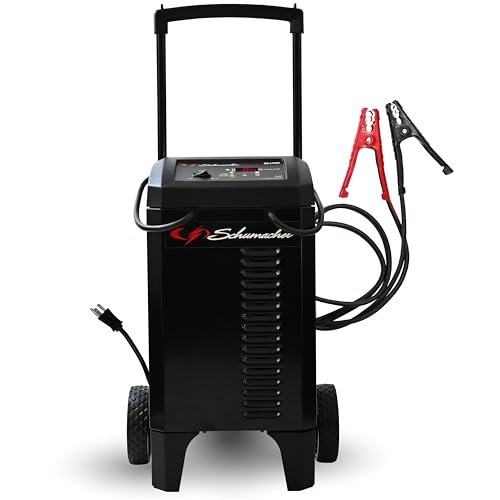
Schumacher SC1400 Wheeled Charger

Schumacher SC1355 1.5A Maintainer

Schumacher SC1308 6A Multi-Function

ACDC 2-Gauge E-Z-GO TXT Cable Set

Schumacher SC1361 12V Charger

CRAFTSMAN CMXCESM258 12A Charger

Schumacher SC1281 6A Charger/Starter

Schumacher SC1445 Wheeled 250A Starter

Schumacher SC1446 Wheeled 10A Charger
Why These Options Stand Out
The opening pick sits in a different lane than the chargers that follow. Rather than topping off a 12V starter battery, the Mehrpow 48V lithium kit replaces an entire golf-cart battery bank at once. It arrives as a complete upgrade package aimed at cart owners tired of swapping lead-acid packs every few seasons.
Anyone running an E-Z-GO, Club Car, or similar 48V system and weighing a chemistry switch will appreciate the one-box approach. The kit ships as a non-returnable hazardous-materials item, so plan the swap carefully and confirm compatibility with your cart’s controller and cable gauge before ordering.
Why It Works Well
- Full 48V 100AH conversion arrives in a single package rather than six loose cells.
- Lithium chemistry weighs roughly a third of comparable lead-acid banks, easing strain on cart frames and helping range on hills.
- Built around Grade A EVE LiFePO4 cells, a widely respected cell line in this category.
- Expected cycle life far outpaces AGM (Absorbent Glass Mat, a sealed lead-acid style) packs, reducing long-term replacement frequency.
Things To Consider
- Hazardous-materials shipping rules mean you’ll want to double-check fitment before ordering, since returns are limited.
- Cart controllers, cable lugs, and chargers may need a quick review to confirm lithium compatibility.
Who It Suits Best
Golf-cart owners planning a one-and-done lithium conversion on a 48V system.
Where Another Pick Suits Better
For owners still running lead-acid carts and just upgrading wiring, the ACDC 2-Gauge E-Z-GO TXT Cable Set is the closer fit.
Stepping into the automotive side of the list, the SC1400 is the wheeled, all-purpose unit that anchors a serious garage. It rolls out of the corner, clips onto a battery, and handles charging, maintaining, and starting duties on cars, trucks, SUVs, and farm gear.
Compare it with the Mehrpow lithium kit at #1: that one replaces the battery bank, while this one keeps whatever battery you already have alive. Heavy engine-starting capability pairs with the wheels-and-handle form factor, making it a fit for older vehicles with stubborn batteries rather than a tidy shelf charger.
What Pays Off
- Wheeled design means you can roll it to the vehicle instead of lifting it onto a workbench.
- Multi-mode operation covers charging, maintaining, and engine starting in one chassis.
- Rugged housing suits garages, workshops, and farm-shed environments.
Honest Caveats
- Larger footprint than compact maintainers, so smaller apartments may find it bulky.
- More capability than occasional drivers will tap, making it a slight overkill for daily commuters.
Feature Card
Best Suited To
Home mechanics, small workshops, and farm owners who want a single wheeled unit for charging and starting.
Not Your Match When
You’re after a compact maintainer for a stored motorcycle, where the Schumacher SC1355 will serve better.
Downshifting from the wheeled SC1400, the SC1355 is the calm, slow-drip option. It pushes just 1.5A into 6V or 12V batteries, the kind of gentle current that suits a motorcycle tucked into winter storage or an ATV waiting out the off-season.
The 3-in-1 design covers charging, maintaining, and reconditioning, meaning it can nurse a slightly sulfated battery (one with lead-sulfate crystals built up on its plates) back to usefulness rather than just topping it off. Lightweight, easy to wall-mount in a garage, and quiet enough to leave running.
What It Does Well
- Gentle 1.5A rate is kind to small batteries on motorcycles, ATVs, and lawn tractors.
- Dual 6V and 12V support covers everything from vintage roadsters to modern compact cars.
- Reconditioning mode helps recover batteries left sitting too long between rides.
Small Caveats
- Too slow to revive a deeply discharged large truck battery in a hurry.
- No engine-start assist, so it pairs best with maintainer duty rather than emergency jump-starts.
Right Fit For
Riders and weekend-tinkerers storing vehicles for weeks or months at a time.
Look Elsewhere When
You need a faster recovery on a dead truck battery, where the CRAFTSMAN CMXCESM258 12A charger is the smarter pick.
The SC1308 packs six functions into a fairly compact unit: charger, maintainer, engine starter, battery tester, alternator tester, and desulfator (a mode that sends high-frequency pulses to break down sulfate buildup on battery plates). It carries the same 6A charge rate as the SC1400 but trades wheels for a feature-dense bench footprint.
For the diagnostic-minded DIYer who likes seeing voltage and condition readouts before deciding what to do, this one reads like a small toolbox. It costs a bit more in cognitive load to learn, but pays that back with information you’d otherwise need a separate multimeter for.
Bright Spots
- Onboard testing reads battery and alternator health without extra tools.
- Desulfation mode can revive batteries that simpler chargers would declare dead.
- Compact shell fits a garage shelf better than the wheeled SC1400.
Points To Note
- Engine-start current is modest compared to wheeled models like the SC1445 at #9.
- More menu options can feel busy to a first-time user.
Quick Facts
Who Should Grab It
DIYers who want diagnostic readouts built into the charger rather than across multiple devices.
Skip It When
You just need a fast no-nonsense charger, where the CRAFTSMAN CMXCESM258 is the cleaner call.
The midpoint of the list belongs to a wiring kit, not a charger. The ACDC 2-gauge set is purpose-built for E-Z-GO TXT carts running high-output controllers, where factory cables can’t safely carry the current a lithium swap or motor upgrade demands.
Each cable is hydraulic-crimped (compressed with a high-pressure tool for a gas-tight metal-to-metal bond) and finished with dual-wall heat-shrink, and the 13-piece spread covers the typical pack-to-pack and pack-to-solenoid routing on a TXT chassis. The braided PET (polyethylene terephthalate) jacket also lets you color-code the install.
Benefits That Matter
- 2-gauge EPDM-jacketed (ethylene propylene diene monomer, a tough synthetic rubber insulation) welding cable rated to handle up to 200 amps cleanly.
- PET braid color choice adds a clean, organized look in the battery compartment.
- Hydraulic crimps and dual-wall heat-shrink keep terminations solid under vibration.
Areas To Watch
- Specific to E-Z-GO TXT models, so other cart brands won’t drop in without rework.
- No charger included, so it pairs with the Mehrpow kit at #1 or an existing onboard charger.
Perfect Match For
E-Z-GO TXT owners upgrading controllers, motors, or battery banks above stock output.
Swap It Out When
You need a complete lithium swap rather than just new cables, in which case the Mehrpow 48V lithium kit is the broader solution.
The SC1361 narrows the focus to 12V systems only, dropping the 6V switchgear that adds cost to siblings like the SC1308. For most modern cars, SUVs, and light trucks on the road, that’s exactly the lane you want to live in.
The 3-in-1 design handles charging, maintaining, and engine starting. It’s the kind of workhorse a household with one or two daily drivers plugs in once a month and forgets about, knowing the battery will be topped off when needed.
Real-World Strengths
- Focused 12V-only design keeps controls simple for daily-driver use.
- Combined maintainer and engine-start function reduces the number of separate tools in the garage.
- Manageable footprint fits on a workbench or shelf without dominating it.
Less Ideal Details
- Won’t serve classic 6V vehicles, so collectors will want the SC1308 instead.
- Engine-start rating is modest compared to the wheeled SC1445 at #9.
Whose Shelf It Belongs On
Daily-driver households with a single sedan, SUV, or light truck in regular use.
Reach For A Different Pick When
You regularly work on 6V classics alongside modern vehicles, where the SC1308 dual-voltage unit makes more sense.
The CRAFTSMAN CMXCESM258 steps up the charge rate to 12 amps, roughly double the speed of the Schumacher 6A units earlier in the list. For households juggling multiple vehicles with mixed battery types, that faster recovery time genuinely matters.
Compatibility with standard, AGM, 12V lithium (LiFePO4, or lithium iron phosphate), and deep-cycle batteries (designed for repeated full discharge and recharge, common in marine and RV use) covers the realistic mix you’ll find in a multi-vehicle garage. The micro-processor-controlled unit also switches itself into maintenance mode once full charge is reached.
Positive Takeaways
- 12A rapid charge cuts recovery time on a dead battery roughly in half versus 6A units.
- Multi-chemistry support covers AGM, LiFePO4, standard, and deep-cycle batteries.
- Microprocessor-controlled operation switches to maintenance automatically, reducing the risk of overcharging.
Trade Offs
- Higher amp output means more heat generated in the housing during long charging sessions.
- Larger and heavier than the gentler SC1355 maintainer at #3.
Built With In Mind
Multi-vehicle households with mixed battery chemistries and a need for faster recovery.
Where A Sibling Pick Shines
For a single-vehicle owner with a smaller battery, the lighter SC1355 1.5A maintainer handles the job with less bulk.
The SC1281 pairs a 6A charger/maintainer with a 100A engine-start assist. That dual-voltage 6V/12V capability puts it in the same family as the SC1308 at #4, but with a noticeably stronger jump-start rating for those really cold mornings.
Where the SC1308 leans into diagnostics, this one leans into recovery: reviving a flat battery and cranking a reluctant engine are the headline acts. It’s a confidence-inspiring tool for anyone whose daily driver spends nights outside in a cold climate.
Notable Upsides
- 100A engine-start assist gives real cranking power on stubborn batteries.
- Dual 6V/12V support covers classic cars and modern vehicles alike.
- Fully automatic operation reduces manual monitoring during charging.
Factors To Consider
- Heavier than the maintainer-only SC1355, so storage takes more shelf space.
- Fewer onboard diagnostic readouts than the SC1308.
Made For
Cold-climate drivers who want charging and jump-starting in one chassis.
A Better Fit Elsewhere
For pure diagnostics-driven charging without the start-assist weight, the SC1308 is the more focused option.
The SC1445 is the heavy hitter for serious workshop use. With a 250A engine-start rating and manual operation, it leans into the hands-on, no-frills approach that experienced mechanics tend to prefer. Many smart chargers refuse to even detect a deeply discharged battery; this one will crank it.
Wheeled construction matches the SC1400 at #2, but the SC1445 trades fully automatic operation for stronger start output. In a farm shop, an old-garage restoration bay, or a busy independent mechanic’s stall, that trade pays off.
Points In Its Favor
- 250A manual engine-start rating handles diesel trucks and heavy equipment.
- Wheeled chassis rolls between bays without straining your back.
- Manual control can rescue deeply discharged batteries that automatic units refuse to engage.
Worth Bearing In Mind
- Manual operation demands more user attention than the automatic SC1361 at #6.
- Oversized for casual at-home use in a single-vehicle household.
Feature Snapshot
Who Should Grab It
Workshops, restoration garages, and farm owners who need brute-force starting power.
Look Elsewhere When
You’d rather set and forget with automatic charging, in which case the SC1361 is a calmer choice.
Rounding out the list, the SC1446 shares the wheeled form factor of the SC1445 but steps down to a 10A charging-focused profile without the heavy engine-start rating. It’s aimed at drivers who want hands-on control over the charging process without the bulk of a starter-class unit.
Older tractors, classic trucks, and any vehicle with a battery that smart chargers sometimes fail to recognize all benefit from manual charging. For a farm property or a hobbyist garage, that’s a meaningful capability.
Practical Pluses
- Manual charging mode recovers batteries that automatic units may reject as “dead.”
- 10A rate offers faster recovery than 6A chargers without the weight of starter-class units.
- Wheeled chassis suits garages and barns where mobility matters.
Things To Weigh
- Manual operation means paying closer attention during longer charge cycles.
- Less specialized for diagnostics than the SC1308 at #4.
Who Will Love This
Farm owners, restoration hobbyists, and DIYers with older vehicles that smart chargers sometimes can’t read.
Consider Something Else When
You need automated set-and-forget maintenance on a daily driver, where the SC1361 fits the routine better.
What To Weigh Before Choosing A 200 Amp Charger
Match The Charger To The Battery
Start with what you’re actually charging. A lithium golf-cart pack like the Mehrpow kit at #1 needs different handling than a 12V lead-acid starter battery, so voltage and chemistry compatibility should come first. The SC1308 and SC1361 both handle dual chemistries, while the SC1361 narrows to 12V-only for simpler controls. If you’re servicing classic 6V vehicles alongside modern ones, dual-voltage support avoids owning two separate units.
Think About How You’ll Use It
A 1.5A maintainer like the SC1355 makes sense if your car sits for weeks at a time, but it’s painfully slow on a dead battery. Daily-driver households often benefit from the CRAFTSMAN CMXCESM258’s 12A rate, which recovers batteries roughly twice as fast as the 6A units. Workshops with stubborn engines and older vehicles gravitate toward manual wheeled units like the SC1445, which deliver stronger starting current without overcomplicating the charging side.
Consider The Space And Storage
Wheeled units such as the SC1400, SC1445, and SC1446 demand floor real estate, while benchtop chargers like the SC1308 and SC1361 fit on shelves. Lithium-conversion projects pair the Mehrpow battery kit with the ACDC cable set for proper routing, so plan garage space for both the battery bank and the wiring harness before the install begins.
Key Considerations Across These Picks
Common Shopping Slip Ups
A frequent misstep is buying a high-amp starter when a maintainer would do the job, or grabbing a gentle maintainer when a faster charger is what’s really needed. Match the unit to the worst-case battery in your garage rather than the average one. Another trap is overlooking cable gauge on lithium upgrades: factory wiring often can’t safely carry the current a higher-output system produces, which is why pairing the Mehrpow kit with the ACDC 2-gauge set matters.
Where The Extra Money Goes
Higher-tier models in this category tend to add engine-start assist, larger amp ratings, and diagnostic readouts. The SC1445’s 250A start rating reflects heavier transformer and clamp components compared to the SC1361, and that hardware shows up in the price. Whether the upgrade pays off depends on how often you actually need that capability. Owners who start many cold-soaked vehicles each winter recover the cost in convenience; occasional users may be better served by a smaller, cheaper unit.
Frequently Asked Questions
What does “200 amp” actually mean on a battery charger?
It refers to the peak current the unit can deliver, typically during an engine-start burst rather than a steady charge. Charging current is usually much lower, often 6A to 12A on the units in this roundup, while the 200A or higher rating kicks in for short-duration starting assistance.
Can a 200 amp charger damage a small battery?
It depends on the charger’s modes. Most modern units automatically reduce current for smaller batteries, so a smart charger is generally safe across sizes. Manual units like the SC1445 require the operator to monitor and adjust, which is why they’re better suited to experienced users with larger batteries.
Do I need a special charger for lithium batteries?
Lithium chemistries like LiFePO4 benefit from chargers with dedicated lithium modes and proper voltage cutoffs. The CRAFTSMAN CMXCESM258 supports 12V LiFePO4 directly, while chargers without that mode may undercharge or fail to fully balance a lithium pack.
How long does it take to charge a dead car battery?
With a 6A charger, a typical 50Ah (amp-hour) passenger battery takes roughly 8 to 10 hours from a deep discharge. The 12A CRAFTSMAN CMXCESM258 cuts that roughly in half, while smaller maintainers like the SC1355 may take a full day or longer on a deeply discharged battery.
Can a battery charger replace a jump starter?
Not always. Chargers restore a battery over hours, while jump starters deliver a quick burst of high current for immediate engine cranking. Wheeled units like the SC1445 blur the line by offering both functions, but a pure maintainer like the SC1355 won’t jump-start a vehicle on its own.
Wrap Up
The right pick depends less on chasing the highest amp number and more on what you actually drive, where it lives, and how often the battery goes flat. Golf-cart owners running lithium benefit most from the Mehrpow kit paired with the ACDC cable set. Daily-driver households usually land on the CRAFTSMAN CMXCESM258 for speed and chemistry flexibility. Cold-climate drivers who need cranking power gravitate toward the SC1281 or SC1445, while long-term storage routines make the SC1355 the gentle, low-cost answer. Match the tool to the situation, and the next dead battery becomes a plug-in rather than a problem.