Heavy-duty battery cable isn’t glamorous, but it’s the difference between a starter that fires on the first try and one that leaves you stranded. Whether you’re wiring a dual-bank system in an RV, hooking up a solar battery wall, or replacing corroded leads under the hood, the cable you choose carries real current through real vibration, real heat, and real weather. Most folks don’t think about battery cable until something fails, and by then you’re choosing at the parts counter with crossed fingers.
This roundup covers ten 2 gauge options that take different approaches to the same job. Some ship as bulk spools for custom runs. Others arrive pre-terminated with lugs already crimped and heat shrink in place. A few include full terminal kits so you can build complete replacement harnesses in an afternoon. Each pick below leans toward a specific kind of build, so the right match depends less on price than on how you actually plan to use it.
Your Options, Compared

WindyNation 2/0 AWG Welding Lead & Car Battery Copper Cable

Shirbly 25FT Red 2 AWG Pure Copper Welding Cable
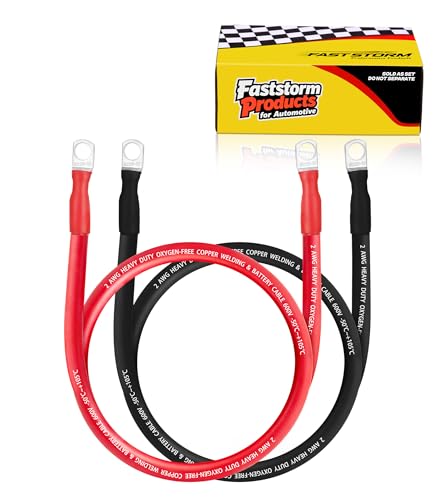
FASTSTORM 2 AWG Flexible Inverter Cables 2FT Pair
FASTSTORM 2 AWG Flexible Inverter Cables 3FT Pair

TEMCo 2 Gauge AWG 10 Ft Black + 10 Ft Red Welding Cable

EWCS 2/0 Gauge Premium Welding Cable 25FT Red

EWCS 2 Gauge Premium Welding Cable 20FT Red
EWCS 2/0 Gauge Premium Welding Cable 50FT Red
EWCS 2 Gauge Premium Welding Cable 25FT Red

FASTSTORM 2 AWG Cable 10Ft Black + 10Ft Red with Lugs Kit
A Closer Look At Each Pick
The WindyNation 2/0 AWG cable earns its spot here because it pairs a genuinely flexible pure copper conductor with a finish that handles real shop abuse. The jacket stays pliable in cold weather, which matters when you’re routing cable through a tight engine bay on a January morning. Available in matched red and black lengths, it suits custom battery bank builds where exact run length determines whether the install looks clean or rattles against the chassis.
For anyone running an inverter off a house battery or wiring a secondary solar array, this cable removes the usual complaint about welding-class wire being stiff. It strips cleanly, crimps predictably with standard lugs, and the copper strands hold their shape after bending. It’s the kind of wire that doesn’t fight back during routing.
A Few Strong Suits
- Pure copper conductor delivers low resistance over long runs, which keeps voltage drop manageable in larger battery banks.
- Highly flexible jacket makes routing through bulkheads and around existing harnesses noticeably easier than generic cable.
- Multiple length choices let you match the actual distance between battery posts without leaving excess coiled behind a panel.
- Suits automotive, RV, inverter, and solar wiring, so the same spool can serve several projects on the bench.
Things To Consider
- 2/0 gauge is thicker and heavier than 2 AWG, so make sure your lugs and terminals are rated for the larger cross-section before ordering.
- Cable ships as raw wire with no terminals included, so you’ll need a crimper and lugs on hand to finish the install.
Key Specs
Made For
DIYers and installers building custom battery banks or inverter runs who want flexibility and don’t mind terminating the cable themselves.
Consider Something Else When
Shirbly 25FT Red 2 AWG Pure Copper Welding Cable suits you better if you only need a single-color 25-foot run for a generator or solar setup.
The Shirbly 2 AWG cable stands out for its strand count, which is the fine-wire construction that lets the cable flex repeatedly without the copper work-hardening. That makes it a comfortable choice for automotive engine bays where vibration and heat slowly fatigue cheaper wire. The 25-foot length also hits a sweet spot for many home generator and solar projects where you want a single run from battery to inverter without splicing.
It also helps that the cable carries a 600-volt rating, which gives headroom for inverter outputs and any future equipment upgrades you might plan. If your shop already has a heat gun and a crimping tool, this is a clean option for terminating to taste.
The Upside
- Fine-strand OFC (oxygen-free copper) construction stays flexible in cold conditions, which simplifies winter installs.
- 600V rating covers inverter output scenarios and gives plenty of margin under typical 12V and 24V battery loads.
- 25-foot length bridges the gap between short patch cables and full spools for most single-run projects.
- EPDM rubber insulation resists oil and solvent exposure common in automotive and shop environments.
Points To Keep In Mind
- Available as a single red cable, so you’ll need to source a separate black cable or wire if your run requires both polarities.
- Stranded fine-wire ends tend to fray during stripping, so a proper cable prep tool saves frustration.
Right Fit For
Shops and homeowners wiring generators, solar charge controllers, or single-polarity battery runs who want a flexible mid-length cable.
A Better Fit Elsewhere
FASTSTORM 2 AWG Flexible Inverter Cables 2FT Pair suits you more if you only need short pre-terminated leads for a battery-to-inverter link.
The FASTSTORM 2-foot pair solves a problem most people don’t anticipate: getting from a battery post to an inverter or starter without leaving cable coiled behind a panel. The short length, matched red-and-black polarity, and pre-crimped 3/8-inch terminals mean you can drop these in and tighten down without dragging out the crimper. It’s the kind of cable that disappears into the build once installed.
Compare that to the WindyNation spool above, which assumes you’ll terminate everything yourself. Here the work is already done, and the tin-plated copper lugs help fight corrosion at the connection point. For most truck, RV, and marine dual-battery setups, these leads feel purpose-built rather than adapted.
Benefits That Matter
- Pre-terminated 3/8-inch tin-plated lugs save a trip to the bench and ensure a consistent crimp every time.
- Matched red and black pair with correct polarity markings removes any guesswork during installation.
- Pure copper conductor delivers low resistance, which matters when you’re pushing high current across a short jump.
- Flexible jacket eases routing in cramped engine bays where stiff cable would fight back.
Less Ideal Details
- Only two feet long, so it’s not suitable for spanning between distant batteries or to a remote-mounted inverter.
- Two-foot length can feel too short if your battery posts sit low and your inverter sits high.
Built With In Mind
Installers and vehicle owners needing short, clean battery-to-equipment leads for dual-battery setups in trucks, RVs, or marine applications.
Look Elsewhere When
FASTSTORM 2 AWG Cable 10Ft Black + 10Ft Red with Lugs Kit works better if you need longer leads plus a full hardware kit for a complete harness.
The 3-foot version of the FASTSTORM pair adds just enough reach to bridge slightly taller battery posts or a wall-mounted inverter without forcing you into a longer, more expensive cable. Like its 2-foot sibling, it ships with the 3/8-inch lugs already crimped, so the install is a matter of bolting down and moving on. For RV and marine cabinets where space matters, that compactness helps.
The extra foot also opens up slightly more flexible routing, which can matter when the inverter sits behind a service panel rather than directly adjacent to the battery. If you’ve ever wrestled with a cable that’s just slightly too short, this length solves that without forcing you into bulk wire.
Real Benefits
- Three-foot length bridges most battery-to-inverter gaps in RVs, boats, and off-grid enclosures without excess slack.
- Tin-plated copper lugs resist corrosion at the terminal, which matters in marine and outdoor battery compartments.
- Pre-terminated leads eliminate crimp variability and let you focus on routing rather than tool setup.
- Pure copper cable handles the high current demands of inverters without significant voltage drop.
Trade-Offs
- Lugs arrive in 3/8-inch only, so verify your equipment studs match before ordering.
- Three feet may still feel short on larger battery banks with widely separated posts.
Quick Facts
Whose Shelf It Belongs On
Van lifers, boat owners, and RV renovators who want clean, pre-made leads for inverter installs with a little more reach than the shortest options offer.
Skip It When
TEMCo 2 Gauge AWG 10 Ft Black + 10 Ft Red Welding Cable is the better fit when you need bulk cable to run multiple circuits across a vehicle or trailer.
TEMCo’s 2 AWG cable is the one to reach for when the install environment is rough and you don’t want to think about the cable again for a decade. The EPDM (a synthetic rubber known for toughness and weather resistance) jacket shrugs off oil, grease, abrasion, and flame, and the cable stays flexible from sub-zero cold up to past the boiling point of water. For trucks, RVs, and trailers that see real weather, that resilience pays off over the long haul.
Compared to the FASTSTORM leads above, this cable asks you to bring your own lugs and crimper, but it rewards that effort with bulk length for multi-circuit runs. The 10-foot black and 10-foot red pairing gives you enough material to handle most automotive banks without splicing.
The Case For It
- Rugged EPDM jacket resists cuts, tears, abrasion, water, oil, and grease, which suits under-hood and chassis routing.
- Wide operating temperature range means the cable won’t crack in winter or soften in summer engine bays.
- Made-in-USA construction with annealed copper conductor for consistent crimping and low resistance.
- Paired red and black 10-foot lengths cover most dual-battery or full-trailer wiring jobs out of the box.
Some Limits To Know
- Bulk cable requires separate purchase of lugs, terminals, and heat shrink to finish the install.
- 10 feet per leg may be more than you need for compact under-hood repairs, leaving excess to stow.
Who It Suits Best
Truck, RV, and trailer owners running multi-circuit battery systems who want tough cable and don’t mind terminating it themselves.
Swap It Out When
EWCS 2 Gauge Premium Welding Cable 25FT Red is a stronger fit when you want a longer single-color coil for solar or workshop projects.
EWCS’s 2/0 cable moves up to a thicker conductor than 2 AWG, which is the right call for high-amperage off-grid systems and inverter banks pushing serious current. The 25-foot length gives enough run for most small cabin solar arrays or workshop battery walls, and the highly stranded copper stays workable even at this gauge. Sunlight and water resistance add a layer of insurance for outdoor conduit runs.
It also happens to be made in the USA, which matters to anyone who likes knowing where their wire came from. If you’ve ever stripped a cable that felt sandy or brittle, you’ll appreciate the consistency here. The 600-volt rating leaves room for high-voltage inverter outputs as well.
Useful Touches
- 2/0 gauge handles higher amperage than 2 AWG, which suits larger inverter banks and demanding off-grid loads.
- Sunlight and water resistance protect outdoor conduit runs in solar and remote-cabin installations.
- Highly stranded 30-gauge copper construction keeps the cable flexible despite the heavier conductor.
- Made in the USA with quality-controlled packaging for consistent insulation thickness.
Possible Compromises
- Red-only offering means a separate black cable is needed for negative runs in dual-polarity systems.
- 2/0 gauge is heavier and stiffer than 2 AWG, so plan lug sizes and bend radii before routing.
Feature Snapshot
Perfect Match For
Off-grid installers and cabin owners wiring battery banks and inverter outputs where heavier gauge and weather resistance both matter.
Where Another Pick Suits Better
EWCS 2/0 Gauge Premium Welding Cable 50FT Red is the better call when your solar array requires longer single-run cable between panels and the battery bank.
The 20-foot EWCS sits in a useful middle ground for anyone who wants made-in-USA cable without committing to a 25- or 50-foot spool. The 2 AWG conductor handles most residential inverter and automotive battery duties, and the 600-volt rating covers anything you’re likely to throw at it in a home setup. Sunlight and water resistance make it equally comfortable indoors or in a garage conduit run.
Where it differs from the Shirbly cable earlier is mainly in origin and strand flexibility. Both are highly stranded, but the EWCS tends to feel slightly more refined under the fingers. If you do a lot of custom builds and value consistent feel across your stock, that uniformity is worth noticing.
Useful Strengths
- 20-foot length fits mid-sized inverter and battery bank runs without leaving excess coiled in a cabinet.
- 600V rating supports inverter output applications with plenty of safety margin.
- Sunlight and water resistant jacket allows mixed indoor and outdoor routing without separate cable stock.
- Made in the USA, with quality-controlled insulation thickness for predictable strip-and-crimp work.
Where It Is Less Suited
- Red-only color, so you’ll need a separate black cable if you want matched polarity runs.
- 20 feet can feel short when spanning a long vehicle chassis or a remote battery enclosure.
Best Suited To
Custom builders and serious DIYers wiring inverter systems in sheds, garages, and small cabins who want USA-made cable in a moderate length.
Reach For A Different Pick When
WindyNation 2/0 AWG Welding Lead & Car Battery Copper Cable makes more sense if your project demands the heavier 2/0 gauge instead of 2 AWG.
When the run between your solar array, combiner box, and battery bank stretches out, the 50-foot EWCS 2/0 spool keeps the voltage drop in check without forcing you to splice shorter pieces. The thicker 2/0 conductor matters more over distance because resistance compounds with every foot, and at 50 feet, 2 AWG would start to bleed meaningful power. This cable solves that problem before it starts.
Like its shorter sibling above, it carries sunlight and water resistance and is made in the USA. For anyone running cable along a roofline, under a deck, or across an outbuilding, that weather resistance removes one of the usual worries about long-term jacket degradation.
A Few Highlights
- 50-foot length bridges long distances between solar arrays, combiner boxes, and battery banks without splices.
- 2/0 conductor keeps voltage drop low across the full run, which preserves inverter efficiency.
- Sunlight and water resistant jacket supports outdoor conduit and exposed routing.
- Highly stranded copper construction maintains flexibility despite the heavier gauge.
Soft Spots
- Red-only offering, so a matched black cable must be sourced separately for negative runs.
- Bulk 2/0 cable is heavy and unwieldy to ship, so plan storage space before the spool arrives.
Who Will Love This
Off-grid homeowners and solar installers running long DC cable runs who want heavier gauge and weather-resistant insulation in one spool.
Where A Sibling Pick Shines
EWCS 2/0 Gauge Premium Welding Cable 25FT Red is the better fit for shorter runs where 50 feet would leave significant waste.
The 25-foot EWCS in 2 AWG gives you the same made-in-USA construction as the rest of the line, just sized for the more common mid-length battery wiring job. At 25 feet, you can usually cover a full inverter-to-battery run, a generator lead, or a secondary feed to an outbuilding without the spool dominating your workbench. It’s the kind of cable you buy once and reach for often.
The stranded copper construction feels notably pliable compared to budget 2 AWG, which makes a difference when routing through conduit bends. For workshops that keep a coil on the shelf for random repair jobs, this length hits a useful balance between capacity and storage footprint.
Where It Helps
- 25-foot length suits inverter runs, generator leads, and outbuilding feeds without excess.
- Highly stranded copper keeps the cable workable in cold weather and tight conduit bends.
- 600V rating covers most DC battery and inverter output scenarios.
- Made in the USA with consistent jacket thickness for predictable strip-and-crimp behavior.
Honest Caveats
- Red-only, so you’ll need a separate black cable for full positive-and-negative runs.
- 2 AWG is right for mid-sized loads, but heavy inverter banks may want 2/0 instead.
Who Should Grab It
Workshops and homeowners who want a versatile mid-length red cable on hand for inverter, generator, and general battery wiring repairs.
Another Choice May Suit
TEMCo 2 Gauge AWG 10 Ft Black + 10 Ft Red Welding Cable is the better fit if matched red-and-black polarity in shorter lengths matters more than a single 25-foot run.
The FASTSTORM kit earns the final slot because it bundles almost everything a DIYer needs for a complete harness rebuild. You get the matched red and black cable, multiple tinned copper lugs in both 5/16-inch and 3/8-inch sizes, and heat shrink tubing to seal the terminations. For anyone replacing a corroded battery harness from scratch, this is the closest thing to an all-in-one package on the list.
Compared to the shorter pre-terminated FASTSTORM leads earlier, this kit assumes you’ll do the crimping yourself, but supplies the hardware to do it properly. If your project calls for custom lead lengths and varied terminal sizes, the included lug assortment saves a separate parts run.
Good Reasons To Consider
- Complete kit with 10 feet each of red and black cable, multiple lug sizes, and heat shrink tubing.
- Tinned copper lugs resist corrosion in marine and outdoor battery compartments.
- Both 5/16-inch and 3/8-inch lugs accommodate a range of battery posts and equipment studs.
- Heat shrink tubing included for clean, sealed terminations without a separate supply run.
Practical Considerations
- You’ll still need a heavy-duty crimper to attach the lugs properly, since the kit doesn’t include tooling.
- 10 feet per leg may leave excess for compact repairs, so plan your cuts before starting the install.
Feature Rundown
Right Fit For
DIYers rebuilding a battery harness from scratch in a car, boat, RV, or solar setup who want cable, lugs, and shrink tubing in a single kit.
A Better Fit Elsewhere
FASTSTORM 2 AWG Flexible Inverter Cables 3FT Pair works better if your install only needs short, factory-crimped leads without extra hardware.
What To Weigh Before Picking 2 Gauge Battery Cables
Gauge, Length, And Current Load
The “2 gauge” label refers to the American Wire Gauge (AWG) system, where smaller numbers mean thicker wire. 2 AWG handles roughly 100 to 150 amps depending on run length and insulation rating, which suits most automotive starters, mid-sized inverters, and battery-to-battery jumpers. The 2/0 AWG cables in this list step up to roughly 200 amps and make sense for high-amperage inverter banks or long solar runs where voltage drop (the loss of voltage as current travels through wire resistance) becomes a concern. Measure your actual run distance before choosing, since longer distances demand thicker conductor to keep voltage drop below about three percent.
Conductor Quality And Strand Count
Pure copper and oxygen-free copper (OFC) conductors offer lower resistance than copper-clad aluminum, which matters in 12V and 24V systems where small voltage losses translate to noticeable efficiency hits. Fine-strand copper also stays flexible in cold weather and around tight bends, which simplifies routing. Heavier strand counts generally mean easier handling but slightly higher cost.
Insulation, Jacket, And Environment
Battery cable insulation takes a beating from heat, oil, vibration, and weather. EPDM and similar synthetic rubber jackets resist abrasion, oil exposure, and temperature swings better than basic PVC. For marine, outdoor, or under-hood installs, sunlight and water resistance extend service life considerably. Match the jacket to your environment rather than buying the toughest option for a benign indoor run.
Pre-Terminated Leads Versus Bulk Cable
Pre-terminated pairs with lugs already crimped save bench time and remove crimp variability. Bulk spools with separate lugs give you control over lead length and terminal choice but require a heavy-duty crimper and heat shrink. Kits like the FASTSTORM package split the difference by including lugs and shrink with the cable. Your choice depends on whether you value speed or customization more.
Key Considerations Across These Picks
Pitfalls Shoppers Hit
A few common mistakes trip up first-time battery cable shoppers. Ordering cable that’s too thin for the actual amperage load is the most frequent, followed by underestimating run length and ending up short. Buying copper-clad aluminum when you needed pure copper is another budget trap, since aluminum cable has higher resistance and different termination requirements. Finally, mismatching lug size to terminal stud size leads to loose connections and voltage drop at the joint. Double-check your equipment stud sizes and total run distance before clicking order.
Where The Extra Money Goes
Spending more on battery cable typically buys three things: heavier gauge, finer copper strand count, and tougher jacket materials. Heavier gauge handles more current and longer runs. Finer strands improve flexibility and reduce fatigue over time. Tougher jackets like EPDM resist the oil, heat, and abrasion that destroy cheaper PVC-insulated wire. For vehicles, marine, and outdoor installs, those upgrades pay back through longer service life and fewer roadside or dockside surprises.
Frequently Asked Questions
What does “2 gauge” actually mean for battery cable?
2 gauge refers to the AWG (American Wire Gauge) cross-section size of the conductor. In AWG, smaller numbers equal thicker wire, so 2 AWG is thicker than 4 or 6 AWG. It typically handles 100 to 150 amps over short distances, which suits most automotive starters and mid-sized inverter loads.
How long can my battery cable run be before I need thicker wire?
A common rule of thumb is to keep voltage drop below three percent of the system voltage. For a 12V system, that means no more than about 0.36 volts lost across the full round trip from battery to load and back. Runs longer than roughly 10 to 15 feet at high amperage usually benefit from stepping up to 2/0 AWG to stay within that limit.
Can I use welding cable for battery wiring?
Yes, welding cable and battery cable are functionally similar, both using highly stranded copper with flexible insulation. Many off-grid and automotive installers use welding cable for battery runs because it bends easily and resists fatigue well. Just confirm the insulation rating suits your environment and use properly sized lugs.
Do I need special lugs for 2 AWG cable?
Standard copper or tinned copper lugs rated for 2 AWG work for most installs. Marine and outdoor applications benefit from tinned lugs, which resist corrosion better than bare copper. Make sure the lug stud size matches your battery post or equipment terminal, typically 5/16-inch or 3/8-inch.
Is pure copper worth the extra cost over copper-clad aluminum?
For most 12V and 24V battery systems, yes. Pure copper has roughly 40 percent lower resistance than copper-clad aluminum, which means less voltage drop and less heat under load. Aluminum cable also requires different crimping techniques and antioxidant compound at terminations, which adds complexity to the install.
Closing Remarks
The right 2 gauge battery cable depends less on price than on matching conductor size, length, and jacket to the job at hand. Compact pre-terminated leads suit tight engine bay installs. Bulk spools work best for custom runs across vehicles, trailers, and off-grid systems. Match the gauge to your current load, the length to your actual distance, and the jacket to your environment, and the cable you choose will likely outlast the project around it.